
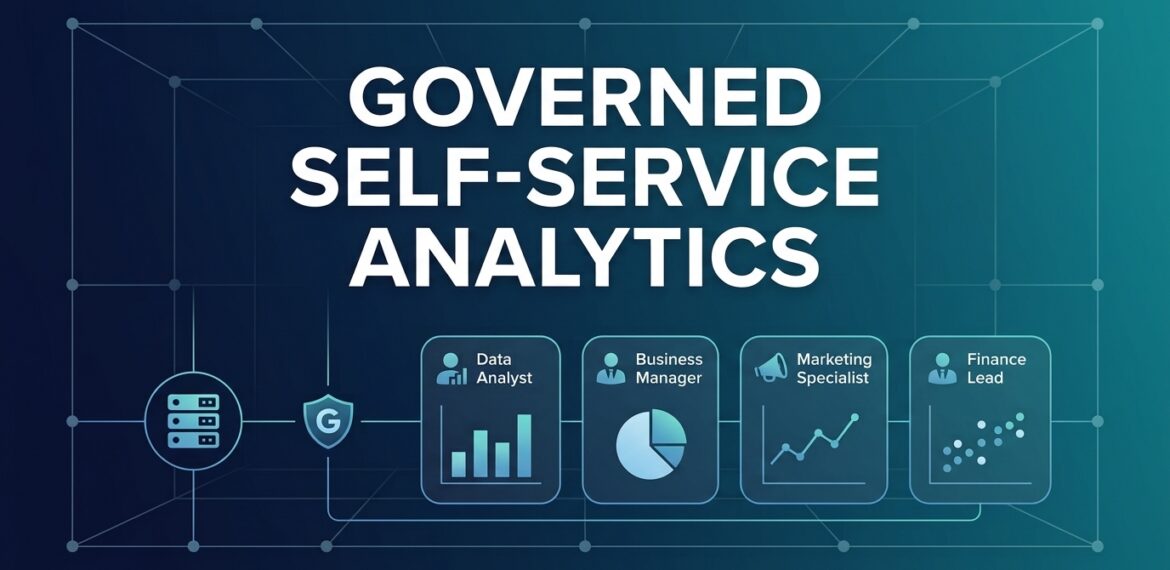
Governed Self-Service Analytics Is Becoming the Real Standard for Modern BI
Governed Self-Service Analytics Is Becoming the Real Standard for Modern BI
 Datahub Analytics Team
For years, self-service analytics was sold as the answer to almost every reporting bottleneck. The promise was simple. Give business users more direct access to data and they will move faster, ask better questions, and reduce dependence on technical teams. That vision was partly right, but many enterprises discovered the downside as well. Without strong governance, self-service often led to duplicated logic, conflicting KPIs, spreadsheet sprawl, and growing mistrust in numbers. In 2026, the conversation is shifting again. Enterprises still want self-service, but they want it grounded in trusted data, governed metrics, and stronger business context. BARC’s 2026 trend research says organizations getting real value from analytics and AI are investing in trustworthy data, governance, security, and strong operational foundations, while Gartner’s 2026 data and analytics trends place semantics and converged data and analytics platforms at the center of AI-first enterprise performance.
This is why governed self-service analytics is becoming the real standard for modern BI. The goal is no longer to let everyone build anything. The goal is to let more people explore and act on data confidently without breaking consistency across the business. That is a much more mature definition of self-service, and it is far more aligned with where enterprise analytics is heading now.
Why Early Self-Service Analytics Often Fell Short
The first generation of self-service analytics solved one problem by creating another. It reduced some dependence on centralized reporting teams, but in many organizations it also scattered business logic across dashboards, spreadsheets, BI tools, and ad hoc calculations. Over time, departments ended up with different versions of revenue, margin, churn, customer counts, or pipeline definitions. That made analytics more available, but not always more trusted.
This is one of the central tensions in modern BI. Business teams want speed and flexibility. Leadership wants consistency and confidence. Technical teams want governance and maintainability. IBM’s overview of self-service analytics describes the value clearly: leaders and frontline users can analyze data without deep technical expertise and act more quickly. But that value only holds when the environment is structured well enough to prevent inconsistent or misleading outputs.
The 2026 market direction suggests enterprises have learned this lesson. Self-service is still important, but the winning model is no longer unmanaged freedom. It is governed flexibility.
What Governed Self-Service Analytics Actually Means
Governed self-service analytics means giving business users the ability to explore, analyze, and act on data independently while keeping the underlying definitions, access controls, and data quality standards aligned across the enterprise. It is not the opposite of self-service. It is what makes self-service sustainable.
In practice, this usually means business users can access curated datasets, approved dimensions, trusted metrics, and governed semantic definitions rather than building everything from raw sources. IBM describes semantic layers as a way to simplify interaction between complex data systems and business users, which is directly relevant here. A semantic layer reduces technical friction for users while preserving more consistency in how core business concepts are defined.
This also means governance is no longer a separate phase that happens after dashboards are built. It becomes part of the design of the self-service environment itself. That is why governed self-service is increasingly becoming the practical middle ground between centralized BI and uncontrolled analytics sprawl.
Why This Trend Is Getting Stronger in 2026
One reason is that analytics is becoming more decision-oriented. BARC’s 2026 trend monitor shows that enterprises are not just chasing more dashboards or more AI features. They are prioritizing trustworthy foundations that make analytics useful in real business settings. That includes data quality, governance, and security. These are exactly the ingredients required to make self-service work at scale.
Another reason is that AI is increasing the cost of inconsistency. As conversational BI, copilots, and AI-assisted analytics become more common, weak definitions and fragmented logic become more visible. A dashboard inconsistency is frustrating. A copilot confidently explaining the wrong KPI is much worse. Gartner’s June 2026 trend view says AI-first enterprises will outperform through AI agents, semantics, and converged data and analytics platforms, which is a strong signal that shared business meaning is becoming essential.
A third reason is that business users still want autonomy. That has not changed. IBM continues to frame self-service analytics as a way to help leaders and frontline users evaluate and analyze data without relying fully on IT. The difference now is that enterprises want this autonomy built on more governed foundations than before.
Why Governed Self-Service Matters for Core Data Analytics
This trend is especially important because it keeps analytics focused on business value rather than tool complexity. At its best, BI should help teams answer questions, monitor performance, identify issues, and support decisions. When governance is weak, teams spend too much time arguing over numbers. When governance is too rigid, teams wait too long for insight. Governed self-service helps balance both.
In data analytics terms, this means the enterprise can support wider access to dashboards, reports, slice-and-dice analysis, drilldowns, and business exploration without turning every user into a data engineer. IBM’s Cognos Analytics positioning reflects this blend by combining self-service modeling, advanced reporting, dashboards, and AI-driven insights inside one governed BI environment. Even though the vendor framing is product-specific, the broader point is relevant: self-service works best when it sits inside a governed system, not outside of one.
This is why governed self-service is increasingly central to analytics modernization. It improves speed, but it does so in a way that still supports enterprise trust.
The Role of Semantic Consistency in Self-Service BI
One of the biggest reasons self-service fails is semantic inconsistency. Users may have access to the same raw data and still end up with different answers because they define the business differently. Revenue may include adjustments in one dashboard but not another. Active customers may be measured by one team monthly and another team weekly. Margin may be calculated differently across regions.
This is where semantic layers and governed metric definitions matter so much. IBM describes the semantic layer as a key piece of architecture that simplifies interactions between complex storage systems and business users. That simplification is not only about usability. It is also about consistency. When the business defines important metrics once and reuses them across tools and teams, self-service becomes much more reliable.
Gartner’s 2026 trends place semantics directly alongside AI agents and converged platforms as a force shaping AI-first enterprises. That is highly relevant for BI, because self-service is only as strong as the shared meaning beneath it.
How AI Fits Into the Picture Without Replacing BI Discipline
AI is clearly influencing the future of BI, but it does not eliminate the need for governed analytics. If anything, it increases it. IBM defines augmented analytics as the use of AI and machine learning capabilities to enhance analytics platforms and automate parts of analysis. Gartner’s 2025 prediction said 75% of analytics content would use GenAI for enhanced contextual intelligence by 2027. Those signals show that AI is becoming part of analytics workflows, but they do not suggest business discipline is becoming less important.
In fact, AI works better when governed self-service is already in place. A copilot can explain a KPI more reliably when the KPI is governed. An assistant can help users explore trends more effectively when datasets are curated and access policies are clear. AI can make BI more accessible, but only if the underlying environment is trustworthy enough to support it.
That is why the right goal is not “AI instead of BI.” The better goal is “AI-enhanced BI built on governed self-service.”
Where Enterprises Can Create the Most Value
One strong use case is executive and managerial reporting. Leaders need quick access to trusted performance views without waiting for custom builds each time a question changes. Governed self-service lets them explore approved metrics with more flexibility while reducing the risk of off-book calculations.
Another important area is frontline and operational analytics. IBM notes that self-service analytics helps frontline teams use key internal data sources in real time to improve decisions and workflows. That becomes far more valuable when those users are working from curated, policy-aligned data rather than isolated exports or manual files.
A third area is cross-functional analytics. Many enterprise questions cut across finance, sales, operations, and customer experience. Governed self-service helps these teams work from shared logic instead of producing separate and conflicting versions of the same story. BARC’s 2026 emphasis on trustworthy foundations strongly supports this need for cross-enterprise consistency.
Common Mistakes Companies Make
One common mistake is thinking self-service means unrestricted access to raw data. That usually produces confusion faster than insight. Business users need freedom to explore, but they also need a structure that keeps the exploration meaningful and safe.
Another mistake is overcorrecting in the opposite direction by locking analytics down so tightly that every change requires central team intervention. That may protect consistency, but it often slows adoption and frustrates the business. Governed self-service works because it balances trust and agility rather than choosing one over the other.
A third mistake is adding AI interfaces on top of messy analytics foundations. A natural language layer does not fix inconsistent metrics. It can actually amplify the problem by making bad logic easier to consume. Gartner’s focus on semantics and BARC’s focus on trustworthy foundations both suggest that enterprises should strengthen core analytics discipline before expecting AI to solve business understanding problems.
How to Start with a Governed Self-Service Strategy
A practical starting point is to identify a small set of high-value business metrics that create repeated reporting friction. These are usually things like revenue, margin, active customers, retention, pipeline, order fulfillment, or service resolution. Define them clearly, assign ownership, and make them reusable across the BI environment.
From there, build curated datasets and governed exploration spaces for business users rather than exposing every raw source directly. IBM’s framing of self-service analytics and semantic layers supports this direction by emphasizing easier business access without requiring users to navigate the full technical complexity underneath.
The goal is not to make everything self-service overnight. It is to make the most important analytics areas trustworthy enough that self-service actually improves decisions instead of multiplying confusion.
How Datahub Analytics Can Help
At Datahub Analytics, we help organizations modernize business intelligence so speed and trust can scale together. That includes modern data warehouse design, governed BI environments, semantic consistency, data governance, and analytics strategies that support self-service without losing control of business logic.
If your organization is struggling with dashboard sprawl, conflicting KPIs, slow reporting cycles, or self-service initiatives that created more confusion than value, a governed self-service model can provide a more durable path forward. The objective is not simply to give users more access. It is to give them access to analytics they can actually trust.
Conclusion
Governed self-service analytics is becoming the real standard for modern BI because enterprises no longer want to choose between agility and trust. BARC’s 2026 trend research shows that trustworthy foundations remain essential for analytics and AI success, while Gartner’s 2026 trends make it clear that semantics and converged data and analytics platforms are now core to enterprise performance.
The future of data analytics will not belong to organizations with the most dashboards or the most unrestricted access. It will belong to organizations that make trusted analysis easier for more people. That is what governed self-service delivers, and that is why it is becoming one of the most important foundations for modern business intelligence.



