
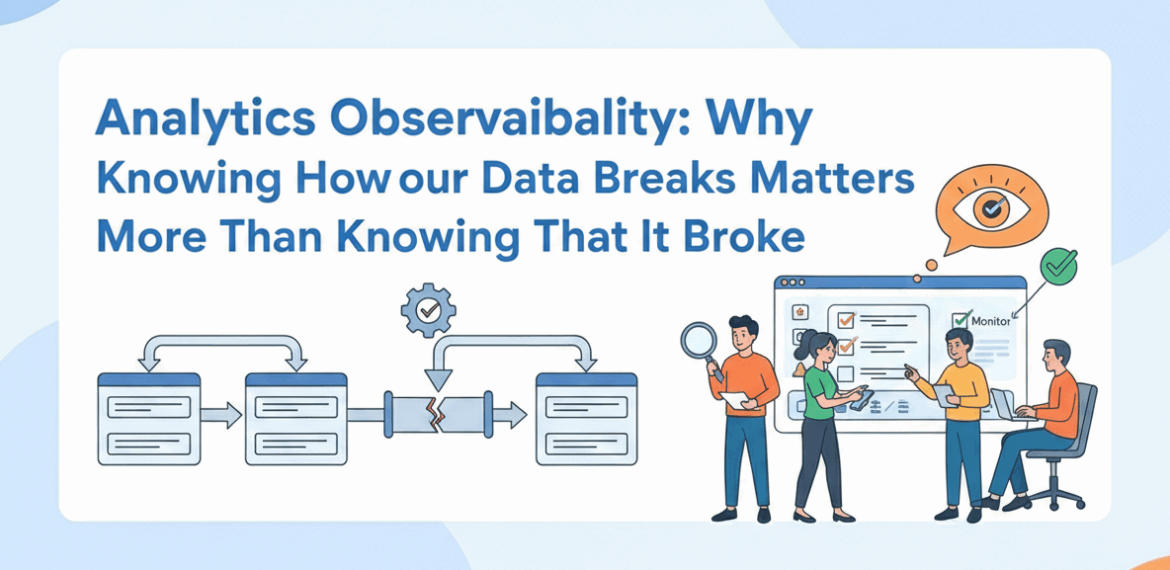
Analytics Observability: Why Knowing How Your Data Breaks Matters More Than Knowing That It Broke
Analytics Observability: Why Knowing How Your Data Breaks Matters More Than Knowing That It Broke
 Datahub Analytics Team
As enterprises become increasingly data-driven, analytics systems have grown larger, faster, and more complex. Data flows through dozens of pipelines, transformations, and tools before it reaches dashboards, reports, or AI models. Yet when something goes wrong, teams often discover the issue only after business users lose trust – or worse, after a bad decision has already been made.
This is why analytics observability is emerging as a critical capability for modern data platforms. It shifts the focus from simply detecting failures to understanding why they happen, where they originate, and how they impact the business.
Why Traditional Monitoring Is No Longer Enough
Most organizations already monitor their data systems – at least superficially. Pipelines are checked for failures, jobs are tracked for completion, and infrastructure metrics are logged. While this type of monitoring is necessary, it is not sufficient for today’s analytics environments.
Modern data problems are often subtle. A pipeline may run successfully, but produce incomplete data. A dashboard may load correctly, but reflect outdated metrics. A machine learning model may score predictions on time, but drift quietly away from accuracy.
Traditional monitoring tells you when systems are up or down. Analytics observability tells you whether your data itself is healthy and trustworthy.
What Is Analytics Observability?
Analytics observability is the practice of continuously monitoring, measuring, and understanding the behavior of data across its entire lifecycle – from ingestion to consumption.
It focuses on answering questions such as:
-
Is the data complete, fresh, and accurate right now?
-
Has something changed unexpectedly in volume or distribution?
-
Which upstream pipeline caused a downstream issue?
-
Who and what is affected by this data problem?
-
Is this an isolated incident or a systemic risk?
Rather than reacting to broken dashboards, observability enables teams to proactively manage data reliability.
The Shift from Reactive to Proactive Analytics
In many organizations, data issues are still discovered by business users. Someone notices a KPI looks wrong, flags it to the BI team, and a long investigation begins. By the time the issue is fixed, confidence has already been damaged.
Analytics observability changes this dynamic. By continuously analyzing data behavior, systems can detect anomalies the moment they occur – often before anyone notices a problem.
This proactive approach reduces downtime, improves trust, and frees data teams from constant firefighting.
Key Signals Observability Focuses On
Analytics observability does not rely on a single metric. Instead, it looks at multiple behavioral signals that indicate whether data is behaving as expected.
These signals typically include:
-
Freshness – Is the data arriving on time?
-
Volume – Has the amount of data changed unexpectedly?
-
Schema – Have structures or fields changed?
-
Distribution – Are values drifting from normal patterns?
-
Lineage impact – Which downstream assets depend on this data?
By combining these signals, teams can understand not just that something changed, but whether that change is meaningful or harmful.
Why Observability Is Critical for Trust
Trust is the foundation of analytics adoption. When users doubt the reliability of data, they stop using dashboards, question insights, and revert to intuition or spreadsheets.
Analytics observability supports trust by making data behavior transparent. Instead of hiding issues, it surfaces them clearly – along with their scope and impact. This transparency reassures users that data problems are being actively managed, not ignored.
Over time, this builds confidence not just in the data, but in the teams responsible for it.
Observability in the Age of Self-Service and AI
As organizations embrace self-service analytics and AI-driven decision-making, observability becomes even more important.
Business users exploring data independently need assurance that what they see is reliable. AI models trained on poor-quality data amplify errors at scale. Automated decisions based on faulty inputs can create serious operational or reputational risks.
Observability provides the guardrails that allow self-service and automation to scale safely.
How Analytics Observability Differs from Data Quality Checks
Traditional data quality checks are often static and rule-based. They verify whether data meets predefined conditions – such as non-null fields or valid ranges.
Observability goes further. It is dynamic and behavior-driven. Instead of asking, “Does this field meet a rule?”, it asks, “Is this data behaving the way it normally does, and if not, why?”
This distinction matters because many real-world data issues do not violate explicit rules. They violate expectations.
Common Scenarios Where Observability Adds Value
Analytics observability proves especially valuable in environments with high change and complexity.
For example, when upstream systems are modified, observability can immediately highlight downstream impacts. When new data sources are added, it can detect unexpected shifts in volume or distribution. When business definitions evolve, it can reveal inconsistencies across reports and teams.
In each case, the goal is not just detection – but understanding and resolution.
How Observability Improves Data Team Productivity
Without observability, data teams often spend a disproportionate amount of time troubleshooting. Investigations are manual, slow, and frustrating. Root causes are hard to trace across multiple pipelines and tools.
Observability reduces this burden by:
-
Automatically detecting anomalies
-
Pinpointing likely root causes
-
Showing lineage and downstream impact
-
Reducing noisy alerts
-
Prioritizing issues by business importance
This allows teams to focus more on delivering value and less on chasing issues.
Analytics Observability as a Business Capability
While observability starts as a technical practice, its impact is deeply business-oriented. It enables organizations to define reliability expectations, align analytics with business SLAs, and measure data health as a first-class metric.
Some organizations even tie observability metrics to executive dashboards, reinforcing the idea that data reliability is as important as performance or revenue.
This elevates analytics from a support function to a strategic capability.
Challenges in Adopting Analytics Observability
Despite its benefits, observability requires a shift in mindset. Organizations may struggle with:
-
Defining what “normal” data behavior looks like
-
Integrating observability across fragmented data stacks
-
Avoiding alert fatigue
-
Aligning technical signals with business impact
-
Changing culture from reactive to preventive
These challenges are real, but they are solvable with the right frameworks and phased adoption.
How Datahub Analytics Helps Organizations Build Observability
Datahub Analytics helps enterprises design analytics observability frameworks that fit their data platforms and business needs.
Our approach includes:
-
Mapping critical data flows and dependencies
-
Defining reliability metrics aligned with business usage
-
Implementing anomaly detection across pipelines and dashboards
-
Establishing lineage-driven impact analysis
-
Integrating observability into BI and analytics workflows
-
Supporting teams with managed analytics and platform expertise
We help organizations move beyond firefighting toward predictable, trustworthy analytics.
Conclusion: You Can’t Scale Analytics Without Observability
As data ecosystems grow, failures are inevitable – but surprises shouldn’t be. Analytics observability gives organizations the visibility they need to understand data behavior, prevent silent failures, and maintain trust at scale.
In a world where decisions are increasingly automated and insights are expected instantly, knowing how and why your data behaves the way it does is no longer optional.
Analytics doesn’t just need to be fast or powerful.
It needs to be observable.



