
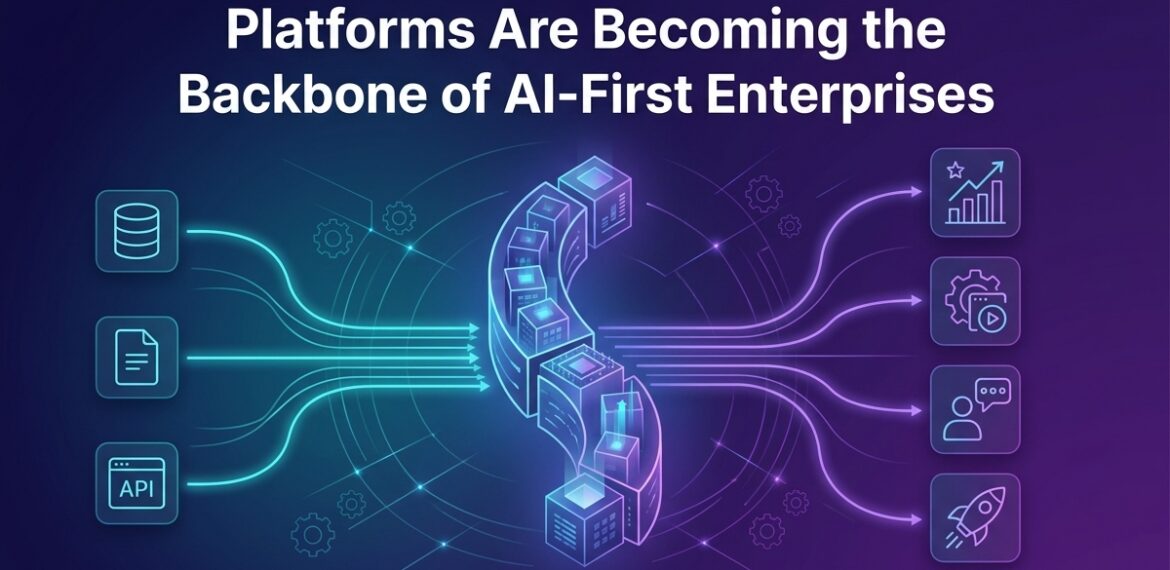
Converged Data and Analytics Platforms Are Becoming the Backbone of AI-First Enterprises
Converged Data and Analytics Platforms Are Becoming the Backbone of AI-First Enterprises
 Datahub Analytics Team
Enterprise data strategy is shifting from tool expansion to platform consolidation. For years, many organizations built their analytics environments by layering separate tools for ingestion, transformation, storage, governance, BI, and AI. That model delivered flexibility, but it also created friction. In 2026, the market conversation is moving toward convergence. Gartner said on June 16, 2026 that more than one in 10 enterprises will be AI-first by 2030 and outperform competitors through the adoption of AI agents, semantics, and converged data and analytics platforms. That is a strong signal that platform convergence is no longer being framed as optional simplification. It is being treated as part of the operating model for enterprise AI.
This matters because AI is pushing data environments beyond traditional reporting. Modern enterprise platforms now need to support analytics, governance, AI agents, real-time workloads, and operational decision support at the same time. IBM’s Think 2026 data recap says the standard for AI-ready data is now higher than simple access, with leading organizations focusing on real-time streaming, contextual enrichment, and trust. That makes fragmented architectures harder to manage, because the business is no longer asking platforms only to store and query data. It is asking them to become the execution environment for intelligent systems.
Why Fragmented Data Stacks Are Starting to Break Down
The earlier generation of enterprise data architecture often assumed that best-of-breed tooling was the right answer. One tool handled ingestion. Another handled transformation. Another managed governance. Another supported BI. Another supported AI experimentation. Over time, that created flexible but complicated stacks that many enterprises now struggle to operate efficiently. Thoughtworks’ 2026 view says that in the AI era, simply having a centralized data platform is no longer enough, especially when that platform cannot adapt to AI-driven demands across the business.
This fragmentation becomes more painful when AI moves into production. Security controls, lineage, policy enforcement, metadata, and cost management all become harder when the business depends on many loosely connected systems. IDC’s December 2025 framework for converged workloads argues that modern converged platforms help analyze live operational data while preserving responsiveness and applying governance in one place instead of stitching controls across multiple stacks. That is exactly the kind of architectural pressure many enterprises are now facing.
What a Converged Data and Analytics Platform Actually Means
A converged data and analytics platform brings multiple data and analytics capabilities into a more unified operating environment. Instead of pushing teams to work across many disconnected layers, it combines more of the lifecycle in one coordinated foundation. In practice, that often means closer alignment between data engineering, governance, analytics, AI workloads, and operational data access. Gartner’s 2026 trend framing puts converged data and analytics platforms alongside AI agents and semantics as one of the three major forces shaping AI-first enterprises.
The value of convergence is not only technical simplification. It is organizational coordination. When business logic, governance, access patterns, and analytics execution live in more unified environments, the enterprise can reduce duplication and shorten the path from data to action. IDC’s converged workloads framework highlights this by tying convergence to real-time enterprise needs, transactional responsiveness, and front-loaded governance rather than after-the-fact control.
Why This Trend Is Accelerating in 2026
One reason is that AI adoption is now affecting revenue, platform strategy, and infrastructure investments directly. Reuters reported on May 27, 2026 that Snowflake raised its fiscal 2027 product revenue forecast and signed a $6 billion AWS deal as enterprise adoption of AI applications grew and more data workloads migrated to its cloud platform. That is a concrete market signal that data platform choices are now increasingly tied to AI readiness, not only to classic warehousing or reporting needs.
Another reason is that AI data readiness is becoming a major spending priority. Gartner’s May 13, 2026 London summit highlights said the share of AI spending focused on AI data readiness will increase seven times from 2025 through 2029, driven by the essential need for AI-ready data. The same highlights also said that by 2027, spending focused on multistructured data management will account for 40% of all spending on data management technologies and services. These signals point to the same conclusion: enterprises need platforms that can handle broader data complexity without multiplying operational fragmentation.
A third reason is that enterprises are moving from platform ownership to ecosystem responsibility. IBM’s Think 2026 recap says the organizations progressing from AI experimentation into AI transformation are streaming data in real time, enriching it with context, and ensuring it is trusted. That raises the bar for the underlying platform. A disconnected stack can support pieces of that journey, but convergence makes it easier to turn those requirements into one governed operating environment.
Why Converged Platforms Matter for Enterprise Analytics
This trend matters directly to analytics teams because analytics is no longer isolated from the rest of the data estate. BI, semantic layers, AI copilots, operational intelligence, and governance increasingly need to work together. Gartner’s 2026 trend view does not place converged platforms at the periphery. It puts them at the center of AI-first enterprise performance. That makes sense because analytics now depends on much more than dashboards. It depends on governed access, shared meaning, and the ability to serve both human and machine consumers from the same environment.
Convergence can improve analytics in practical ways. It can reduce the time spent reconciling definitions across tools, improve consistency between operational and analytical data, and make it easier to apply policies and lineage across the full workflow. IDC’s converged workloads framework emphasizes that governance becomes easier when controls are applied up front in one place, which is especially valuable when AI-driven analytics and real-time decisions are using the same data foundations.
The Connection Between Converged Platforms and AI Readiness
AI readiness is increasingly a platform question, not just a model question. Many enterprises already have access to powerful models. What they often lack is a coordinated environment where data is discoverable, real-time where needed, enriched with business context, and governed consistently. IBM’s 2026 guidance describes AI-ready data in exactly those terms, and Gartner’s 2026 trends reinforce that AI-first enterprises need more than models. They need semantics and converged platforms as well.
This matters because AI systems amplify platform weaknesses. If governance is scattered, AI sees inconsistent controls. If data access is fragmented, AI sees incomplete context. If semantics are disconnected, AI produces answers that sound fluent but fail in business terms. Converged platforms help reduce those gaps by bringing more of the control plane and execution plane into one environment. That is why convergence is increasingly being discussed as part of trustworthy AI, not only as an IT simplification exercise.
Where Enterprises Can Gain the Most Value
One strong use case is real-time operational analytics. IDC says converged platforms are designed to analyze live operational data while preserving transactional responsiveness. That matters for businesses trying to support AI-assisted workflows, embedded intelligence, and operational decisions without creating separate stacks for “run the business” and “analyze the business.”
Another major area is enterprise AI deployment at scale. Reuters’ Snowflake report shows how closely AI application growth is now linked to data workload migration and platform investment. When enterprises want to scale assistants, copilots, or data-driven AI products, platform convergence can reduce integration overhead and make deployment more repeatable.
A third area is AI-ready data modernization. Gartner’s London summit highlights on AI data readiness spending and multistructured data management suggest that enterprises are preparing for more complex data demands, not fewer. A converged platform can help absorb that complexity without forcing every new requirement into another disconnected tool or manual integration layer.
Why Convergence Does Not Mean Going Backward
Some organizations hesitate because they associate convergence with older ideas of monolithic platforms. That is not what the market is pointing to now. The 2026 convergence discussion is not about returning to rigid all-in-one systems with little flexibility. It is about reducing unnecessary fragmentation while supporting AI, governance, real-time analytics, and business context more cohesively. Thoughtworks’ 2026 perspective is useful here because it argues that the enterprise now needs AI-ready data ecosystems, not static centralized platforms that cannot adapt to new demands.
In other words, convergence works best when it increases coordination without killing adaptability. The enterprise still needs openness, interoperability, and domain awareness. But it also needs fewer control gaps and less operational duplication. That is why convergence is rising now. It is not a retreat from modern architecture. It is an attempt to make modern architecture governable at AI scale.
Common Mistakes Companies Make
One mistake is treating platform convergence as a procurement exercise only. Buying a more unified platform does not automatically fix weak governance, poor semantics, or unclear operating models. Gartner’s framing makes clear that converged platforms matter alongside semantics and AI agents, not in isolation from them.
Another mistake is assuming fragmented stacks are always more agile. In some cases they are, but as AI readiness becomes more important, fragmentation can create slower delivery, duplicated logic, and weaker controls. IBM’s 2026 recap and IDC’s converged workload guidance both suggest that trust, real-time readiness, and coordinated governance are now central advantages, not nice-to-have additions.
A third mistake is ignoring the role of data readiness. Gartner’s London summit highlights on sevenfold growth in AI data readiness spending show that the biggest bottleneck is often not access to models. It is the condition of the underlying data environment. Without fixing that, platform change alone will not deliver the intended value.
How to Start with a Converged Platform Strategy
A practical starting point is to identify where fragmentation is already hurting performance. That might be repeated integrations across tools, conflicting business logic, weak policy enforcement, slow AI deployment, or operational data that cannot easily support analytics and decision systems together. IDC’s converged workloads framing suggests that the strongest value comes where enterprises need both operational responsiveness and analytical insight at the same time.
From there, the organization should focus on the shared layers that matter most: governance, semantics, data access, lineage, and AI-readiness. Gartner’s 2026 trends suggest that the winning pattern is not just more AI, but AI supported by converged platforms and stronger business meaning. That makes convergence a strategic sequencing decision, not only a technical architecture choice.
How Datahub Analytics Can Help
At Datahub Analytics, we help organizations modernize their data environments so analytics, governance, and AI can scale together more effectively. That includes modern data architecture, business intelligence transformation, semantic consistency, AI-ready data foundations, and platform strategy aligned with business outcomes. In a market where AI-first enterprises are being shaped by agents, semantics, and converged data and analytics platforms, the right architecture is no longer just an IT concern. It is a business capability.
If your organization is struggling with tool sprawl, weak coordination between analytics and AI, or rising pressure to make data genuinely AI-ready, a converged platform strategy may be the right next move. The goal is not simply to centralize more technology. It is to create a more unified and governed environment where trusted data can move more directly into insight, action, and enterprise value.
Conclusion
Converged data and analytics platforms are rising because enterprise AI is exposing the limits of fragmented architectures. Gartner’s 2026 trends place converged platforms alongside AI agents and semantics as the defining pillars of AI-first enterprises, while IDC, IBM, and Reuters all point to the same broader pattern: real-time responsiveness, AI-ready data, and scalable governance are becoming harder to deliver through disconnected stacks alone.
The next phase of enterprise analytics will not be defined only by better models or more dashboards. It will be defined by whether organizations can create a data environment where analytics, AI, governance, and operational execution work together as one coordinated system. Enterprises that get that convergence right will be better positioned to move faster, govern better, and create more durable value from both data and AI.



