
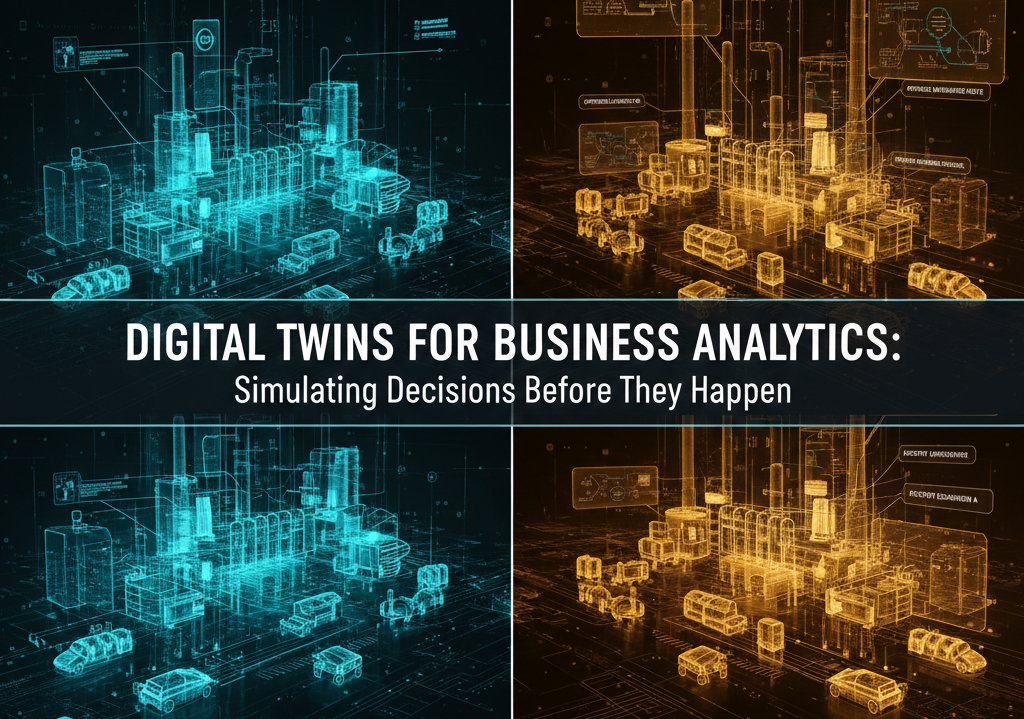
Digital Twins for Business Analytics: Simulating Decisions Before They Happen
Digital Twins for Business Analytics: Simulating Decisions Before They Happen
 Datahub Analytics Team
Enterprises have always relied on data to understand what is happening inside their business. But understanding alone is no longer enough. Leaders now want to test decisions before committing to them, anticipate outcomes, and reduce risk in an increasingly complex environment. This is where digital twins for business analytics are beginning to play a transformative role.
Originally popularized in manufacturing and engineering, digital twins are now moving beyond physical assets into business processes, customer journeys, supply chains, and entire operating models. When combined with analytics and AI, they allow organizations to simulate reality – helping decision-makers see not just what is, but what could be.
What Is a Digital Twin in a Business Context?
A digital twin is a dynamic, data-driven virtual representation of a real-world system. In business analytics, that system might be:
-
A supply chain
-
A customer lifecycle
-
A pricing and demand model
-
A sales pipeline
-
A workforce planning model
-
An end-to-end business process
Unlike static models or dashboards, a digital twin continuously updates as new data flows in. It reflects the current state of the business while remaining flexible enough to simulate alternative scenarios.
In simple terms, a digital twin allows organizations to experiment safely – without impacting real customers, revenue, or operations.
Why Digital Twins Are Gaining Momentum in Analytics
Business environments are becoming harder to predict. Market volatility, supply disruptions, shifting customer behavior, and regulatory changes all introduce uncertainty. Traditional analytics explains past performance and forecasts likely futures – but it often cannot show how different decisions interact across systems.
Digital twins fill this gap by enabling scenario-based thinking. Leaders can explore questions such as:
-
What happens if demand spikes unexpectedly?
-
How would a pricing change affect churn and revenue?
-
What is the downstream impact of a supply delay?
-
How does changing one KPI affect others?
Instead of debating assumptions, teams can test them.
How Digital Twins Extend Traditional Analytics
Traditional analytics focuses on insight. Digital twins focus on impact.
Dashboards show KPIs.
Predictive models estimate outcomes.
Digital twins simulate the system itself.
This difference is critical. Business systems are interconnected. A change in one area often produces unintended consequences elsewhere. Digital twins make these dependencies visible and measurable.
By combining historical data, real-time signals, business rules, and predictive models, digital twins turn analytics into a living system – not just a reporting layer.
Key Components of a Business Digital Twin
While implementations vary, most business-focused digital twins include several core elements.
There is a data foundation that feeds the twin with historical and real-time data.
There are models – statistical, predictive, or AI-based – that describe how the system behaves.
There are rules and constraints that reflect policies, limits, and operational realities.
There is a simulation layer that allows teams to test scenarios and decisions.
And finally, there is a visual and interaction layer that makes the twin understandable and usable by business users.
Together, these components create a powerful decision-support environment.
Where Digital Twins Deliver the Most Business Value
Digital twins are especially effective in areas where decisions are complex, interdependent, and high-impact.
Supply Chain and Operations
Organizations can simulate inventory policies, supplier disruptions, and logistics changes before implementing them.
Customer Experience
Digital twins of customer journeys help teams test onboarding changes, service improvements, or pricing strategies without risking churn.
Revenue and Pricing
Sales and pricing teams can explore different discounting or bundling strategies and see projected impacts across segments.
Workforce Planning
HR and operations teams can simulate staffing changes, productivity shifts, or demand fluctuations.
Risk and Compliance
Digital twins help model stress scenarios, operational failures, or regulatory changes – supporting proactive risk management.
In each case, the value lies in learning before acting.
Digital Twins and Real-Time Analytics
The real power of digital twins emerges when they are connected to real-time data. As events occur – customer actions, operational changes, market signals – the twin updates continuously.
This creates a feedback loop:
-
Reality feeds the digital twin
-
The twin simulates potential futures
-
Insights guide decisions
-
Decisions influence reality
Over time, this loop improves accuracy, resilience, and confidence in decision-making.
How AI Enhances Digital Twins
AI plays a critical role in making digital twins practical and scalable. Machine learning models help twins learn patterns, adapt to change, and improve predictions as conditions evolve.
Generative AI adds another layer – helping explain simulations, summarize outcomes, and guide users through complex scenarios in natural language. This makes digital twins accessible not just to analysts, but to executives and operational teams.
Challenges in Building Business Digital Twins
Despite their promise, digital twins are not plug-and-play.
Common challenges include:
-
Defining the right level of detail
-
Integrating data across siloed systems
-
Ensuring model accuracy and trust
-
Avoiding over-complexity
-
Aligning stakeholders around assumptions
Successful digital twins start small – focused on a specific decision or system – and evolve over time.
Digital Twins as a Strategic Capability
Digital twins are more than a technical innovation. They represent a shift in how organizations think about decision-making.
Instead of reacting to outcomes, teams learn to anticipate them. Instead of debating opinions, they test scenarios. Instead of relying solely on experience, they combine intuition with simulation.
This capability becomes a strategic advantage in environments where speed, adaptability, and resilience matter.
How Datahub Analytics Helps Build Business Digital Twins
Datahub Analytics helps enterprises design and implement digital twin solutions tailored to business analytics use cases.
Our approach includes:
-
Identifying high-value systems and decisions for simulation
-
Designing data architectures that support real-time twins
-
Building predictive and simulation models
-
Integrating digital twins with BI, analytics, and operational tools
-
Applying governance, transparency, and validation frameworks
-
Supporting teams with analytics, AI, and data engineering expertise
We help organizations move from insight to foresight – safely and intelligently.
Conclusion: The Future Belongs to Businesses That Can Simulate Change
As uncertainty becomes the norm, the ability to test decisions before making them will define successful enterprises. Digital twins bring this capability into the heart of business analytics.
They don’t replace analytics – they extend it.
They don’t remove judgment – they strengthen it.
By combining data, models, and simulation, digital twins turn analytics into a proactive, decision-ready capability.
In the future of analytics, the most valuable insight may not be what happened – but what happens if we choose differently.



