
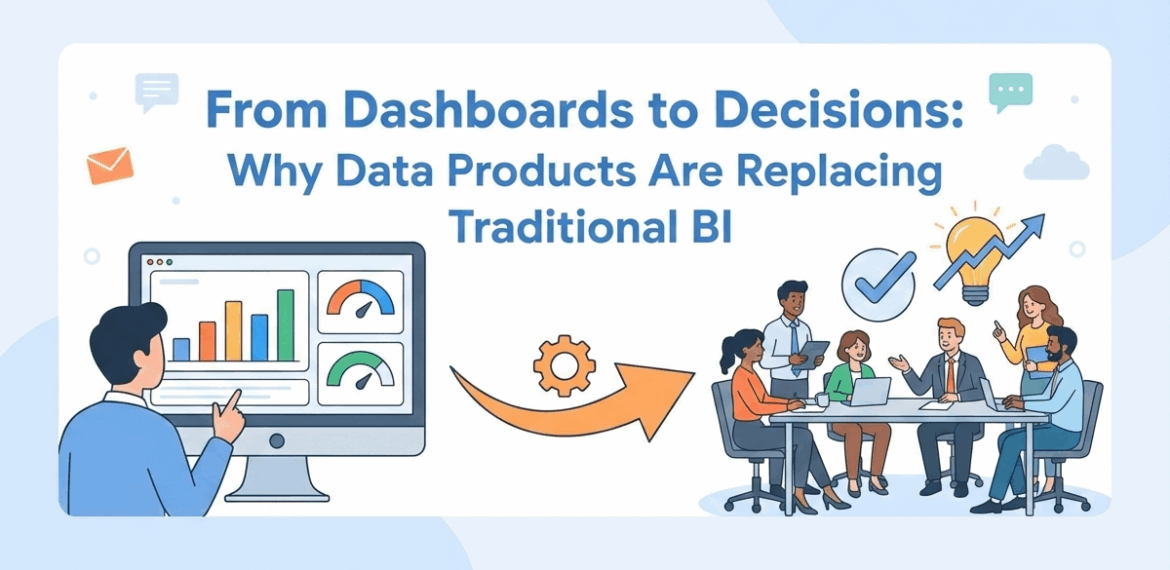
From Dashboards to Decisions: Why Data Products Are Replacing Traditional BI
From Dashboards to Decisions: Why Data Products Are Replacing Traditional BI
 Datahub Analytics Team
For years, Business Intelligence focused on dashboards, reports, and KPIs. While these tools brought visibility, they often stopped short of driving action. Teams could see what was happening – but translating insight into outcomes still required manual effort, interpretation, and follow-ups. As organizations mature in their data journeys, this gap has become impossible to ignore.
This is why many enterprises are shifting from traditional BI to a data product operating model. Instead of treating analytics as static outputs, they are treating data as a product – designed, owned, measured, and continuously improved to deliver business value.
Why Traditional BI Is No Longer Enough
Dashboards are useful, but they have limitations. They are typically built for broad audiences, updated periodically, and consumed passively. In fast-moving environments, this creates friction.
Common issues with traditional BI include:
-
Insights that arrive too late to influence outcomes
-
Reports that lack ownership once delivered
-
KPIs that are visible but not actionable
-
Limited alignment between analytics and business workflows
-
Growing dashboard sprawl with declining adoption
As businesses demand faster decisions and tighter alignment with operations, analytics must move closer to where work actually happens.
What Is a Data Product?
A data product is not just a dataset or a dashboard. It is a purpose-built, reusable asset designed to serve a specific business need.
A data product typically includes:
-
Curated and governed data
-
Clearly defined metrics and logic
-
Embedded analytics or insights
-
Integration into business workflows
-
SLAs for quality, freshness, and reliability
-
An owner accountable for outcomes
In short, a data product delivers insight in context, not just information in isolation.
How Data Products Change the Analytics Mindset
The shift to data products represents a fundamental change in how organizations think about analytics.
Instead of asking, “What reports do we need?”, teams ask, “What decisions are we enabling?”
Instead of measuring success by dashboard delivery, success is measured by adoption, impact, and business outcomes.
This mindset aligns analytics with product thinking – prioritizing user experience, value delivery, and continuous improvement.
Data Products vs Dashboards
Dashboards focus on visibility. Data products focus on usability and action.
A dashboard might show churn rates.
A data product might identify at-risk customers, explain drivers, and trigger retention workflows.
A dashboard might display inventory levels.
A data product might predict stockouts and integrate with replenishment systems.
This difference is subtle – but powerful. Data products close the gap between insight and execution.
Key Characteristics of Successful Data Products
While data products vary by use case, successful ones tend to share common traits.
They are purpose-driven, designed around a specific decision or workflow.
They are owned, with clear accountability for quality and outcomes.
They are discoverable, easy for users to find and trust.
They are embedded, integrated into tools people already use.
They are measurable, with clear metrics for success and usage.
Most importantly, they are treated as living assets – not one-time deliverables.
Where Data Products Deliver the Most Impact
The data product model is especially effective in areas where analytics must influence action quickly.
Customer Experience
Products that surface churn risk, sentiment shifts, or next-best actions directly into CRM systems.
Revenue and Sales
Products that prioritize leads, forecast pipeline health, or recommend pricing actions.
Operations
Products that detect bottlenecks, predict failures, or optimize resource allocation.
Finance
Products that support real-time forecasting, variance analysis, and scenario planning.
Risk and Compliance
Products that monitor anomalies, flag violations, and support audit readiness.
In each case, the value comes from embedding insight into the flow of work.
The Role of Ownership in Data Products
One of the biggest differences between dashboards and data products is ownership.
Dashboards are often built by central BI teams and handed off. Data products, by contrast, have:
-
A product owner
-
A defined audience
-
Clear success metrics
-
Feedback loops for improvement
This ownership model ensures accountability and prevents analytics from becoming stale or irrelevant.
How Data Products Fit with Modern Data Architectures
Data products align naturally with modern data platforms – cloud data lakes, lakehouses, real-time pipelines, and event-driven systems.
They can be built on top of shared data infrastructure while maintaining domain-level ownership. This approach supports scalability without central bottlenecks and fits well with concepts like data mesh and domain-oriented analytics.
Rather than one centralized BI backlog, teams own and evolve the data products that matter most to their domain.
Challenges in Moving to a Data Product Model
Despite the benefits, adopting a data product approach is not without challenges.
Organizations often struggle with:
-
Defining ownership across business and data teams
-
Shifting culture from project-based delivery to product thinking
-
Aligning incentives with long-term value
-
Balancing governance with autonomy
-
Measuring impact beyond usage metrics
These challenges are organizational as much as technical. Success requires executive sponsorship and clear operating principles.
Why Data Products Are the Future of Analytics
As analytics becomes more embedded, automated, and AI-driven, static dashboards will feel increasingly outdated. Businesses need analytics that adapts, learns, and integrates seamlessly into decision-making processes.
Data products provide that foundation. They allow organizations to scale analytics responsibly, empower teams, and ensure data investments translate into measurable outcomes.
In a world where every team wants data – but not every team wants dashboards – data products offer a more effective path forward.
How Datahub Analytics Helps Organizations Build Data Products
Datahub Analytics helps enterprises design and implement data product operating models that align analytics with business value.
Our work includes:
-
Identifying high-impact data product opportunities
-
Defining ownership, SLAs, and success metrics
-
Designing product-aligned data architectures
-
Building embedded analytics and insight delivery
-
Integrating data products into operational systems
-
Establishing governance without slowing innovation
-
Supporting teams through managed analytics and staff augmentation
We help organizations move from reporting to results – by turning data into products that people actually use.
Conclusion: Analytics Works Best When It’s Productized
The future of analytics is not about more dashboards – it’s about better outcomes. Data products represent a shift toward analytics that is actionable, accountable, and aligned with real business needs.
Organizations that adopt a data product mindset will unlock greater value from their data, increase adoption across teams, and move faster from insight to impact.
In the end, the question is no longer “What should we report?”
It’s “What decisions should our data power?”



