
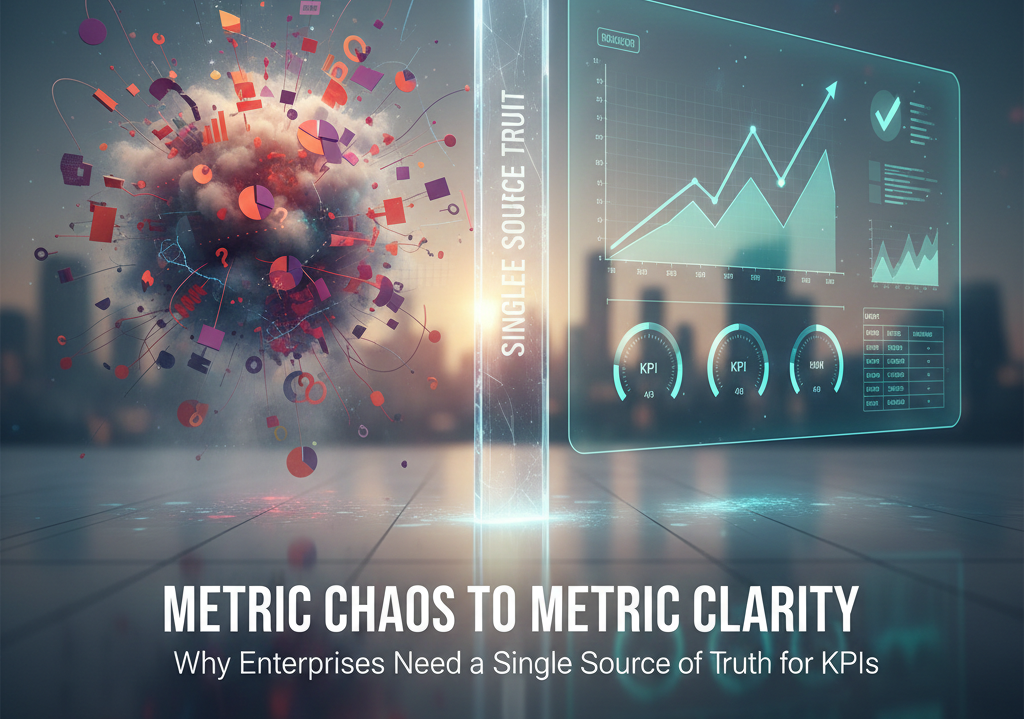
Metric Chaos to Metric Clarity: Why Enterprises Need a Single Source of Truth for KPIs
Metric Chaos to Metric Clarity: Why Enterprises Need a Single Source of Truth for KPIs
 Datahub Analytics Team
Most organizations believe they are data-driven. They invest in BI tools, build dashboards, and track hundreds – sometimes thousands – of metrics. Yet when executives ask a simple question like “What is our actual churn rate?” or “Which revenue number is correct?”, the answers often vary depending on who is asked.
This problem isn’t caused by lack of data. It’s caused by metric chaos.
As analytics environments scale, KPIs multiply across teams, tools, and departments. Without a unified approach, metrics drift, definitions diverge, and confidence in analytics quietly erodes. This is why enterprises are increasingly focusing on metric standardization and a single source of truth for KPIs.
How Metric Chaos Creeps into Organizations
Metric chaos rarely appears overnight. It builds slowly as analytics adoption grows.
Different teams create their own dashboards.
Business units define metrics to suit local needs.
Data models evolve without centralized alignment.
Tools calculate the same KPI in slightly different ways.
Over time, the organization ends up with:
-
Multiple definitions of the same KPI
-
Conflicting numbers across dashboards
-
Manual reconciliations before leadership meetings
-
Endless debates over “whose number is correct”
-
Declining trust in analytics outputs
At this stage, analytics stops accelerating decisions and starts slowing them down.
Why KPI Inconsistency Is a Business Risk
Inconsistent metrics don’t just create confusion – they create risk.
When leaders make decisions based on different versions of the truth, alignment breaks down. Strategic priorities conflict. Performance discussions become subjective. Accountability weakens.
In regulated industries, inconsistent KPIs can also lead to compliance issues. In customer-facing functions, they can result in misaligned incentives and poor experiences.
Most importantly, loss of trust in metrics pushes teams back to intuition, undermining years of analytics investment.
What a Single Source of Truth Really Means
A single source of truth for KPIs does not mean one dashboard or one tool. It means one authoritative definition of each metric, consistently calculated and reused everywhere.
A true KPI source of truth includes:
-
Clear business definitions
-
Agreed calculation logic
-
Consistent dimensional filters
-
Ownership and stewardship
-
Version control and change history
-
Broad reuse across reports, dashboards, and applications
When these elements are in place, metrics become reliable building blocks rather than points of contention.
The Shift from Dashboards to Metric Layers
Traditionally, KPIs were embedded inside dashboards. Each report recalculated metrics independently, leading to duplication and inconsistency.
Modern analytics platforms are shifting toward centralized metric layers – a shared semantic layer where metrics are defined once and reused everywhere.
This approach allows:
-
Consistent KPIs across BI tools
-
Faster dashboard development
-
Easier governance and auditing
-
Better self-service analytics
-
Reduced dependency on central BI teams
Metrics become products, not artifacts.
Why Ownership Matters More Than Tools
Many organizations attempt to solve metric inconsistency by adopting new BI platforms. While tooling helps, the real issue is often ownership.
Every critical KPI needs:
-
A business owner responsible for definition
-
A data owner responsible for calculation
-
Clear documentation of intent and usage
-
A formal process for changes
Without ownership, even the best tools cannot prevent metric drift.
How Metric Clarity Improves Decision-Making
When KPIs are standardized and trusted, decision-making changes noticeably.
Meetings focus on why performance changed, not whether the number is correct.
Teams align faster around priorities.
Executives gain confidence in trends and forecasts.
Analytics adoption increases across the organization.
Metric clarity removes friction from decision-making – and speed becomes a competitive advantage.
Metric Governance Without Bureaucracy
One common fear is that standardizing KPIs will slow teams down. In reality, the opposite is true when governance is designed well.
Effective metric governance:
-
Focuses only on high-impact KPIs
-
Enables reuse rather than restricting access
-
Automates enforcement where possible
-
Allows controlled evolution over time
-
Supports self-service instead of blocking it
The goal is not control – it is consistency with flexibility.
Metric Trust in the Age of AI and Automation
As organizations adopt AI-generated insights, predictive analytics, and automated decision systems, metric trust becomes even more critical.
AI models rely on metrics as features, labels, and evaluation criteria. If KPIs are inconsistent, AI outputs become unreliable – often without obvious warning.
A trusted metric layer ensures that automation and AI are built on stable foundations, reducing risk and improving explainability.
Common Signs You Need a KPI Source of Truth
Organizations often recognize the need for metric standardization when they experience:
-
Conflicting numbers in executive reviews
-
Multiple dashboards answering the same question differently
-
Excessive time spent reconciling reports
-
Low adoption of self-service BI
-
Frequent “metric redefinitions” during performance discussions
These are not tooling problems. They are semantic problems.
How Datahub Analytics Helps Bring Metric Clarity
Datahub Analytics helps organizations move from metric chaos to clarity by designing and implementing KPI standardization frameworks that align business and data teams.
Our approach includes:
-
Identifying critical enterprise KPIs
-
Defining clear business and technical ownership
-
Designing centralized metric and semantic layers
-
Aligning metrics across BI, analytics, and AI platforms
-
Integrating governance into everyday analytics workflows
-
Supporting adoption through managed analytics and staff augmentation
We help enterprises turn KPIs into trusted decision assets – not debate triggers.
Conclusion: Clear Metrics Create Confident Decisions
Analytics delivers value only when people trust what they see. Without consistent KPIs, even the most advanced BI platforms fail to drive alignment or action.
A single source of truth for metrics brings clarity, speed, and confidence into decision-making. It transforms analytics from a reporting function into a strategic capability.
In a data-driven enterprise, clarity is power.
And clarity starts with trusted metrics.



