
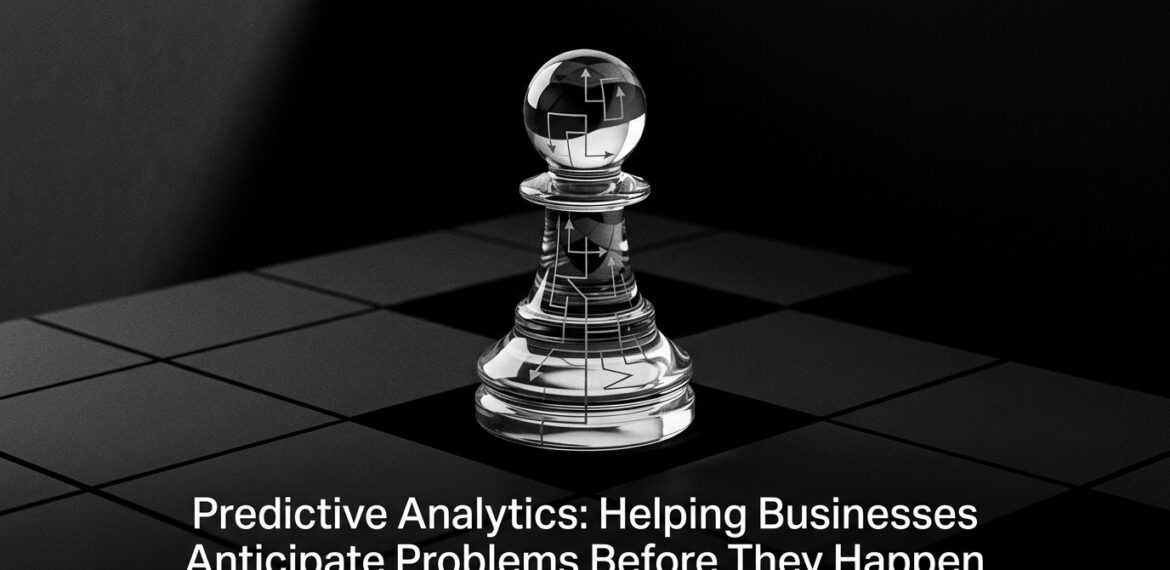
Predictive Analytics: Helping Businesses Anticipate Problems Before They Happen
Predictive Analytics: Helping Businesses Anticipate Problems Before They Happen
 Datahub Analytics Team
Most businesses are good at reviewing the past.
They know last month’s revenue, last quarter’s expenses, yesterday’s sales, previous customer complaints, historical inventory levels, and past operational delays. This information is useful, but it often arrives after the opportunity has passed or after the problem has already affected the business.
Predictive analytics changes this approach.
Instead of only asking what happened, businesses can start asking what is likely to happen next. Which customers may leave? Which products may see higher demand? Which machines may fail? Which payments may be delayed? Which sales opportunities are likely to close? Which delivery routes may face problems? Which costs may increase?
These questions help organizations move from reactive decision-making to proactive action.
Predictive analytics uses historical data, business patterns, statistical methods, machine learning, and advanced analytics to estimate future outcomes. When implemented properly, it can improve planning, reduce risk, increase revenue, optimize operations, and support better decisions across the enterprise.
What Is Predictive Analytics?
Predictive analytics is the use of data, algorithms, and statistical models to forecast future events or behaviors.
It analyzes historical and current data to identify patterns that can indicate what may happen next. The output may be a forecast, probability score, risk rating, recommendation, or early warning signal.
The goal is not to predict the future with perfect accuracy. The goal is to improve decision-making by giving teams earlier and better signals.
From Historical Reporting to Future Signals
Traditional reporting focuses on the past.
A sales report shows what was sold. A finance report shows what was spent. A support report shows how many tickets were closed. An operations report shows what delays happened.
Predictive analytics adds another layer.
It helps estimate future sales, future demand, future churn, future risk, future delays, and future cost movement.
This gives teams more time to act.
Prediction Is Useful Only When It Supports Action
A predictive model should not exist only as a technical experiment.
It should support a business decision.
For example, if a model predicts that a customer may churn, the business should have a retention action. If a model predicts stockout risk, the supply chain team should have a replenishment plan. If a model predicts payment delay, the finance team should know how to follow up.
Prediction becomes valuable when it leads to action.
Why Predictive Analytics Matters for Businesses
Business conditions change quickly.
Customer behavior shifts, costs fluctuate, supply chains face disruption, sales cycles change, and operations become more complex. Businesses that depend only on historical reports may respond too late.
Predictive analytics gives organizations earlier visibility into risk and opportunity.
Faster Response to Business Risks
Many business problems show early warning signs before they become serious.
A customer may reduce engagement before leaving. A product may show demand movement before a stockout occurs. A machine may show abnormal behavior before failure. A deal may slow down before it is lost. A payment may show delay risk before it becomes overdue.
Predictive analytics helps detect these signals earlier.
This allows teams to respond before the issue becomes larger.
Better Planning and Forecasting
Planning becomes more effective when it is supported by data.
Businesses can use predictive analytics to forecast demand, revenue, workforce needs, inventory levels, cash flow, service volume, and operational capacity.
This helps leaders allocate resources more effectively.
Instead of relying only on assumptions, teams can plan using data-driven forecasts.
More Efficient Use of Resources
Resources are always limited.
Sales teams have limited time. Customer service teams have limited capacity. Finance teams have limited review bandwidth. Operations teams have limited inventory and workforce. Marketing teams have limited budget.
Predictive analytics helps prioritize where resources should go.
Teams can focus on high-risk customers, high-value opportunities, likely delays, expected demand changes, or unusual financial patterns.
Improved Customer Experience
Predictive analytics can help businesses serve customers before problems escalate.
A company can identify customers who may need support, accounts that may be dissatisfied, orders that may be delayed, or products that may run out of stock.
By acting early, businesses can improve reliability and customer satisfaction.
Key Business Use Cases for Predictive Analytics
Predictive analytics can support many areas of the business. The best use cases are those where earlier action can create measurable value.
Customer Churn Prediction
Customer churn prediction helps businesses identify customers who may stop buying, cancel a service, reduce usage, or move to a competitor.
The model may analyze purchase frequency, service history, complaints, product usage, payment behavior, engagement level, and customer profile.
This helps sales, customer success, and service teams take retention actions earlier.
For example, a high-value customer with declining usage and repeated complaints may require immediate attention.
Demand Forecasting
Demand forecasting helps businesses estimate future product or service demand.
It can use historical sales, seasonality, promotions, market behavior, customer segments, and external signals.
This supports inventory planning, procurement, workforce planning, production scheduling, and logistics.
Better demand forecasting can reduce both stockouts and excess inventory.
Revenue Forecasting
Revenue forecasting helps leadership understand expected revenue performance.
It may use sales pipeline, deal stages, historical conversion rates, customer behavior, pricing, renewals, seasonality, and market trends.
This supports budgeting, planning, target setting, and resource allocation.
For businesses with complex sales cycles or recurring revenue, predictive revenue analytics can improve confidence in future planning.
Sales Opportunity Scoring
Sales teams often manage many leads and opportunities.
Predictive analytics can score opportunities based on likelihood to convert, expected value, customer fit, engagement signals, industry, deal stage, and historical patterns.
This helps sales teams prioritize the right opportunities.
Instead of treating every lead equally, teams can focus on those most likely to create revenue.
Inventory and Stockout Prediction
Inventory decisions are difficult because businesses must balance availability and cost.
Predictive analytics can help identify products at risk of stockout or overstock based on current inventory, demand trends, supplier lead times, seasonality, and sales velocity.
This helps supply chain teams plan replenishment more effectively.
Predictive Maintenance
For industries that depend on equipment, machines, vehicles, plants, or infrastructure, predictive maintenance can create significant value.
The model may analyze sensor data, usage patterns, maintenance history, operating conditions, failure records, and performance signals.
This helps identify assets that may require maintenance before failure occurs.
Predictive maintenance can reduce downtime, improve safety, and control repair costs.
Financial Risk Prediction
Finance teams can use predictive analytics to identify payment delays, cash flow pressure, fraud indicators, budget overruns, and expense anomalies.
For example, a model may predict which invoices are likely to be paid late based on customer history, invoice amount, payment terms, and past behavior.
This helps finance teams prioritize follow-up and improve working capital visibility.
Workforce and Capacity Forecasting
Organizations can use predictive analytics to forecast workforce needs, service volumes, staffing gaps, attrition risk, and productivity patterns.
This helps HR, operations, and leadership teams plan resources more effectively.
For example, a contact center may forecast expected support volume and adjust staffing accordingly.
The Data Foundation for Predictive Analytics
Predictive analytics depends on strong data foundations.
If data is incomplete, scattered, inconsistent, or poorly structured, predictive models may produce weak or unreliable results.
Integrated Data Across Systems
Predictive analytics often needs data from multiple sources.
A churn model may need CRM data, billing data, support tickets, product usage, marketing engagement, and payment history.
A demand forecast may need sales data, inventory data, promotions, supply chain data, and seasonality.
A revenue forecast may need pipeline data, finance data, customer data, and historical conversion patterns.
This is why data integration is essential.
Businesses need connected data before they can build useful predictions.
Modern Data Warehouse
A modern data warehouse provides a reliable foundation for predictive analytics.
It brings data from different systems into one structured environment. It allows organizations to clean, organize, model, and analyze data at scale.
Without a strong warehouse foundation, predictive analytics may depend on manual extracts and inconsistent datasets.
That makes models difficult to maintain and trust.
Business-Ready Data Models
Predictive models need data that reflects business reality.
Data should be modeled around business entities such as customers, products, orders, transactions, suppliers, assets, employees, accounts, opportunities, invoices, and service requests.
When data is organized around meaningful business entities, predictive analytics becomes more accurate and easier to explain.
Data Quality and Consistency
Predictive models learn from data.
If the data contains errors, duplicates, missing values, outdated fields, or inconsistent definitions, the model may produce poor predictions.
Data quality is not just a technical requirement. It is a business requirement.
Clean and consistent data improves trust in predictive analytics.
Business Intelligence and Predictive Analytics Work Better Together
Predictive analytics should not be isolated from business intelligence.
BI helps users understand what happened. Predictive analytics helps them understand what may happen next. Together, they create a stronger decision-making environment.
Predictive Scores Inside Dashboards
Dashboards can include predictive outputs such as churn risk scores, demand forecasts, late payment risk, deal win probability, maintenance risk, or delivery delay probability.
This makes predictive analytics easier for business users to access.
Instead of opening a separate model interface, users can see predictions inside the dashboards they already use.
Forecast Visualizations
Forecasts are easier to understand when visualized clearly.
A dashboard can show expected revenue, expected demand, expected service volume, or expected inventory levels alongside historical performance.
This helps users compare actual trends with predicted trends.
Exception-Based Monitoring
Predictive analytics can help dashboards focus attention on exceptions.
For example, a dashboard may highlight customers with high churn risk, products with stockout risk, invoices with late payment risk, or assets with maintenance risk.
This helps teams prioritize action.
Role-Based Predictive Insights
Different teams need different predictive insights.
Executives may need revenue and demand forecasts. Sales teams may need deal scoring. Service teams may need churn and escalation risk. Finance teams may need payment and cash flow forecasts. Operations teams may need delay and capacity predictions.
Role-based design improves adoption.
How AI and Machine Learning Strengthen Predictive Analytics
Predictive analytics can use traditional statistical methods as well as machine learning and AI.
The right approach depends on the business problem, data availability, accuracy requirements, and explainability needs.
Machine Learning for Pattern Detection
Machine learning can identify patterns that may not be obvious through manual analysis.
For example, churn risk may be influenced by a combination of service issues, usage decline, payment behavior, customer segment, and product mix.
A machine learning model can analyze these variables together and estimate risk.
AI for Recommendation and Decision Support
AI can go beyond prediction by suggesting actions.
If a customer is at risk, AI may recommend a retention offer or account review. If demand is expected to increase, it may recommend replenishment. If a deal is unlikely to close, it may suggest a follow-up action.
This helps teams move from prediction to decision.
Natural Language Explanations
AI can also help explain predictive insights in simple language.
Instead of only showing a risk score, a system can summarize why the customer is high-risk or why demand is expected to rise.
This improves understanding for business users.
Model Monitoring and Continuous Learning
Predictive models must be monitored over time.
Business behavior changes, customer patterns shift, market conditions evolve, and data sources change. A model that worked well last year may become less accurate later.
Organizations need monitoring, retraining, and improvement processes to keep models useful.
Predictive Analytics and Automation
Predictive analytics becomes more powerful when connected to automation.
Prediction identifies what may happen. Automation helps trigger the right response.
Automated Alerts
If a model detects high churn risk, stockout risk, payment delay risk, or service escalation risk, an alert can be sent to the right team.
This reduces the delay between insight and action.
Workflow Automation
Predictive insights can trigger workflows.
For example:
A high-risk customer can trigger a retention workflow.
A product with stockout risk can trigger a replenishment review.
A late payment risk can create a finance follow-up task.
A high-value opportunity can trigger a sales priority alert.
An asset with failure risk can trigger a maintenance request.
This helps teams act consistently.
RPA for Repetitive Follow-Up
Robotic Process Automation can support repetitive actions such as updating records, sending reminders, generating reports, validating information, and routing cases.
When RPA is connected with predictive analytics, businesses can automate parts of the response process.
This improves productivity and reduces manual effort.
Infrastructure Requirements for Predictive Analytics
Predictive analytics requires more than a model.
It needs scalable infrastructure, reliable data pipelines, analytics platforms, monitoring, and deployment capabilities.
Scalable Data Processing
Predictive analytics may involve large volumes of historical data, real-time signals, customer behavior, transactions, logs, sensor data, and external sources.
Big data infrastructure helps process this information efficiently.
This is especially important for businesses with high transaction volumes or complex operations.
Cloud and Hybrid Architecture
Many organizations have data spread across cloud and on-premise systems.
A hybrid cloud architecture can help connect these environments and support predictive analytics without forcing immediate system replacement.
This is important for enterprises with legacy ERP systems, modern cloud applications, and specialized operational platforms.
Containerized Infrastructure
Predictive models need to be deployed, tested, updated, and scaled.
Containerized infrastructure helps support reliable deployment and portability across environments.
This is useful for AI models, analytics applications, data services, and automation workflows.
DevOps and MLOps Practices
Predictive analytics requires ongoing management.
Data pipelines need monitoring. Models need versioning. Performance needs tracking. Updates need testing. Deployment needs control.
DevOps and MLOps practices help organizations manage analytics and machine learning solutions more reliably.
Managed Infrastructure Support
As predictive analytics environments grow, managing performance, availability, scalability, and monitoring becomes more complex.
Managed infrastructure services can help reduce operational burden and keep analytics platforms reliable.
Common Mistakes in Predictive Analytics Projects
Predictive analytics can create strong value, but many projects fail because they are not connected to practical business needs.
Starting with a Model Instead of a Business Problem
A predictive analytics project should begin with a business question.
What decision needs improvement?
What risk needs earlier detection?
What outcome should be improved?
What action will follow the prediction?
Without this clarity, the model may not create business value.
Using Poor-Quality Data
Predictive analytics depends on historical patterns.
If the data is incomplete, inconsistent, biased, or outdated, the prediction will suffer.
Data quality must be addressed before expecting reliable results.
Ignoring Explainability
Business users need to understand why a prediction matters.
A risk score alone may not be enough. Users often need to know the key drivers behind the prediction so they can take the right action.
Explainability improves trust and adoption.
No Action Plan After Prediction
A model that predicts churn, delay, or risk is only useful if the business can respond.
Predictive analytics should be connected to workflows, ownership, and decision processes.
Treating Models as One-Time Projects
Predictive models need maintenance.
As business patterns change, models must be monitored and improved. Otherwise, accuracy and relevance may decline.
A Practical Roadmap for Predictive Analytics
Organizations can start small and expand predictive analytics over time.
The best approach is to begin with use cases where early action can create measurable value.
Choose a High-Value Use Case
Start with a business problem where prediction can support action.
Good examples include churn prediction, demand forecasting, revenue forecasting, stockout prediction, late payment risk, maintenance prediction, or sales opportunity scoring.
The use case should have clear business value and available data.
Identify Required Data Sources
Map the systems that contain relevant data.
This may include CRM, ERP, finance platforms, customer support systems, marketing platforms, inventory systems, IoT sensors, transaction databases, and spreadsheets.
Build the Data Foundation
Connect data sources, clean data, define business entities, and create reusable models.
This step is critical because the predictive model depends on the quality of the data foundation.
Develop and Test the Model
Build the predictive model and test its performance.
The goal should not be only technical accuracy. The model should also be useful for business decision-making.
Embed Predictions into Dashboards or Workflows
Predictions should be delivered where users can act on them.
This may be inside BI dashboards, CRM systems, service tools, finance workflows, operations platforms, or automated alerts.
Measure Business Impact
Track whether predictive analytics improves outcomes.
This may include reduced churn, better forecast accuracy, fewer stockouts, faster collections, lower downtime, improved sales conversion, or reduced manual effort.
Monitor and Improve Over Time
Continue monitoring model performance, data quality, user adoption, and business impact.
Predictive analytics should improve as the business learns.
How Datahub Analytics Can Help
Datahub Analytics helps organizations design and implement predictive analytics solutions that support better planning, earlier risk detection, and smarter decision-making.
Through its Datahub Analytics services, the company supports big data analytics, modern data warehouse development, business intelligence, data visualization, data science, and robotic process automation. These capabilities help businesses connect data sources, build predictive models, create dashboards, and automate insight-driven workflows.
Datahub Infrastructure supports the technical foundation required for predictive analytics through big data infrastructure, containerized infrastructure, DevOps infrastructure solutions, hybrid cloud infrastructure solutions, and managed infrastructure services. This helps organizations build scalable and reliable platforms for data processing, AI workloads, model deployment, and analytics delivery.
For organizations that need additional expertise or delivery capacity, Datahub Outsourcing provides staff augmentation, AI and ML engineers, managed data analytics, data management, PMO services, and Data & Analytics Centre of Excellence support.
By combining analytics, infrastructure, automation, and expert teams, Datahub Analytics helps businesses move from historical reporting to forward-looking intelligence.
Conclusion
Predictive analytics helps businesses anticipate problems, identify opportunities, and make better decisions before outcomes are fully visible.
It allows organizations to forecast demand, reduce churn, improve sales prioritization, detect risk, plan resources, optimize operations, and improve customer experience.
The value of predictive analytics does not come from algorithms alone. It comes from connecting data, business questions, dashboards, workflows, automation, and action.
For businesses that want to move from reactive reporting to proactive decision-making, predictive analytics offers a practical and powerful path toward smarter performance.



