
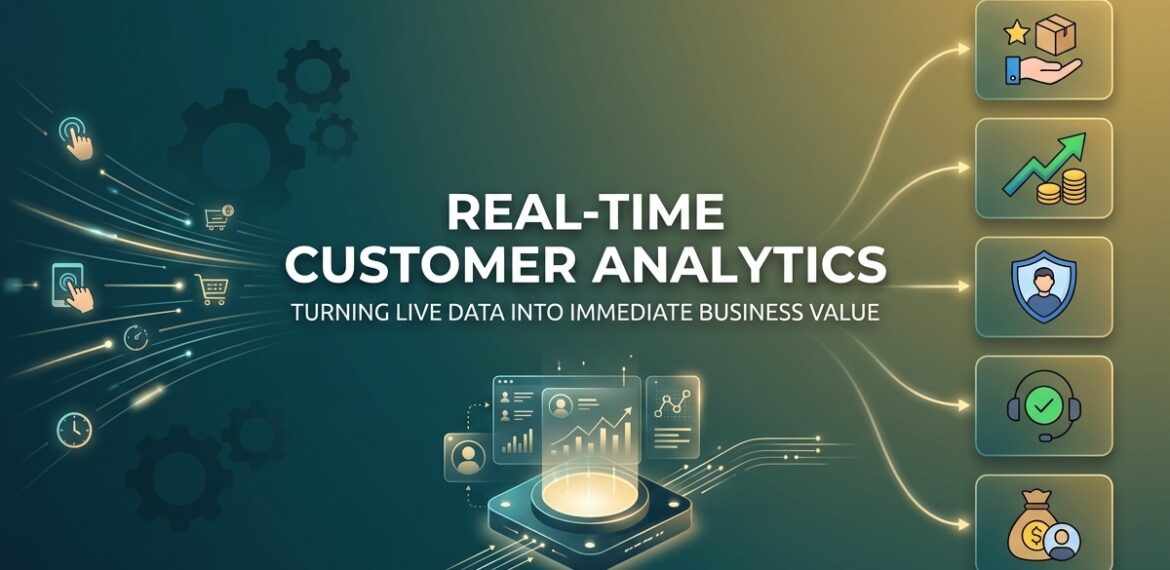
Real-Time Customer Analytics: Turning Live Data Into Immediate Business Value
Real-Time Customer Analytics: Turning Live Data Into Immediate Business Value
 Datahub Analytics Team
Customer expectations are moving faster than traditional analytics cycles. In many industries, monthly reporting and even daily dashboards are no longer enough to support the speed of customer engagement, digital commerce, service operations, and personalized experiences. Businesses increasingly need to understand what customers are doing now, not just what they did last week. That is why real-time customer analytics is becoming one of the most important priorities in modern enterprise data strategy. Recent market research shows that in 2026, analytics is becoming more AI-driven, operational, and decision-oriented, while real-time insight continues to gain importance as organizations push for faster business response.
Real-time customer analytics is not simply about speed for its own sake. It is about relevance. When a business can detect customer behavior as it happens, it can respond with better timing, better personalization, and better decisions. That can influence conversion, churn, service quality, cross-sell performance, and customer satisfaction. In a highly competitive market, timing is often the difference between a missed opportunity and a meaningful business result.
Why Traditional Customer Analytics Is Falling Short
Traditional analytics models were built for historical understanding. They helped organizations see patterns in campaigns, transactions, customer segments, and service performance over time. That remains useful, but it is increasingly incomplete.
A business may know which customers churned last quarter, which offers performed best last month, or which service channel had the highest resolution rate last week. But that does not automatically help when a customer is abandoning a cart right now, showing signs of frustration in a digital journey, or interacting with a service channel at this very moment. In those situations, delayed insight limits the ability to act.
This is where many companies feel the gap. They have data. They have dashboards. They may even have advanced BI platforms. But they still struggle to convert customer signals into timely action. As analytics becomes more embedded into operations and AI-assisted workflows, this gap becomes harder to ignore.
What Real-Time Customer Analytics Actually Means
Real-time customer analytics is the ability to collect, process, analyze, and act on customer-related data with minimal delay. That data may come from websites, mobile apps, call centers, CRM systems, ecommerce activity, payment events, support interactions, loyalty platforms, IoT sources, or marketing channels.
The value is not just in ingesting live data. The real value comes from interpreting it quickly enough to influence the next interaction or decision. That could mean identifying a high-intent visitor and triggering a personalized offer, routing a dissatisfied customer to a higher-priority service path, detecting churn signals early, or adjusting product recommendations in session.
In other words, real-time customer analytics connects insight with immediate action. It shifts analytics from retrospective reporting to live business enablement.
Why This Trend Is Growing Now
Several forces are accelerating the need for real-time customer analytics.
First, customer journeys are increasingly digital and multi-channel. Customers move between mobile apps, websites, social platforms, service channels, marketplaces, and physical touchpoints. That creates a large volume of time-sensitive data that loses value if it is processed too late.
Second, AI is raising expectations around speed and responsiveness. As businesses adopt AI-driven recommendations, automated service workflows, and conversational interfaces, they need fresher data to make those systems effective. Industry trend research for 2026 shows a clear shift toward intelligent, conversational, and decision-oriented BI and analytics.
Third, enterprises are investing more heavily in modern data and AI infrastructure. Recent reporting shows enterprise AI deployment is expected to accelerate over the next 12 to 24 months, especially where organizations want stronger control, faster execution, and closer alignment between data systems and operational outcomes. That broader modernization creates a stronger foundation for real-time analytics use cases as well.
How Real-Time Analytics Changes Customer Engagement
Real-time analytics changes the role of customer data from passive observation to active engagement.
In a traditional setup, customer data often supports after-the-fact analysis. Teams review performance, identify segments, and build future strategies. In a real-time setup, customer data becomes part of the live experience. It informs the next recommendation, the next alert, the next message, the next service action, or the next sales opportunity.
This creates a very different business dynamic. Marketing becomes more adaptive. Service becomes more proactive. Commerce becomes more responsive. Customer experience becomes more personalized in the moment rather than only through broad segmentation. The analytics function itself also becomes more operational, because it is no longer serving only reporting needs. It is supporting live business decisions.
Key Use Cases for Real-Time Customer Analytics
One of the strongest use cases is cart abandonment and conversion recovery. If an ecommerce business can detect hesitation or drop-off during a live session, it can trigger interventions such as reminders, dynamic offers, or assisted support before the opportunity disappears.
Another strong use case is churn prevention. Real-time behavior can reveal early warning signs such as declining engagement, repeated complaints, failed payments, or unusual service interactions. Detecting those signals early allows the business to intervene before churn becomes final.
Customer service is another major area. Real-time analytics can help route cases more intelligently, surface customer history instantly, identify urgency, and improve first-contact resolution. This is especially valuable when service quality directly affects retention and brand perception.
There is also strong value in product and content personalization. When recommendations are based on current customer behavior rather than static history alone, relevance improves. That can increase engagement, dwell time, conversion, and loyalty.
These use cases matter because they tie analytics directly to outcomes, not just visibility.
The Foundation Required to Make It Work
Real-time customer analytics sounds appealing, but it only works well when the foundation is strong.
The first requirement is reliable data integration. Customer signals must be collected across relevant channels and brought together in a usable form. If data remains trapped in disconnected platforms, real-time visibility becomes fragmented.
The second requirement is trusted business logic. Real-time analytics cannot depend on inconsistent definitions of churn risk, active customer status, conversion events, or service priority. As organizations adopt more AI-driven and automated workflows, trustworthy data and governance become even more critical. BARC’s 2026 trend research strongly reinforces that data quality, governance, security, and literacy remain the non-negotiable base for meaningful AI and analytics value.
The third requirement is an architecture that supports fast processing and action. That often includes modern cloud platforms, event-driven data flows, streaming or near-real-time pipelines, and analytics layers that can serve both operational and BI use cases.
Without these foundations, a business may end up with faster data but not better decisions.
Why Governance Matters Even More in Real Time
Some organizations assume speed should come before governance. In reality, the opposite is often true.
The faster decisions are made, the more important it becomes to ensure those decisions are based on trusted data, approved definitions, and appropriate access controls. A delayed dashboard error is a reporting problem. A real-time decision error can become a customer experience problem immediately.
This is especially important as AI agents, copilots, and intelligent applications become more common in enterprise environments. Recent reporting on enterprise AI highlights growing emphasis on trust, rules, and safe access as data-centric AI systems become more deeply embedded into business operations.
For customer analytics, governance also protects brand integrity. Poorly timed offers, irrelevant recommendations, or inaccurate triggers can damage trust. Real-time systems must therefore be not only fast, but also disciplined.
How Real-Time Analytics Supports AI-Driven Business Models
Real-time customer analytics and AI are becoming closely linked. AI models are most useful when they can respond to current context. A recommendation engine works better when it sees fresh behavior. A service copilot performs better when it can access live case data. A churn model becomes more actionable when it is fed near-real-time signals.
That is why real-time analytics is becoming part of AI-readiness. Organizations that want to operationalize AI across customer engagement need not only models, but also timely pipelines, governed data layers, and responsive decision systems. Market research in 2026 continues to show that the organizations gaining the most value from AI are the ones investing in the foundational elements that make those systems reliable.
Common Mistakes Companies Make
One common mistake is trying to make everything real time. Not every metric, workflow, or data product needs instant processing. The best results usually come from focusing on use cases where timing has clear business value.
Another mistake is treating real-time analytics as a technology project alone. While streaming tools and architecture matter, success depends just as much on business alignment, use case selection, governance, and operational execution.
A third mistake is ignoring semantic consistency. If different systems define customer value, churn, engagement, or conversion differently, real-time outputs become unreliable. Speed cannot compensate for inconsistent business meaning.
There is also a risk of overreacting to data. Real-time analytics should improve decision quality, not encourage constant noise-driven intervention. The goal is not to make the business frantic. It is to make it responsive and relevant.
How to Start with Real-Time Customer Analytics
The most practical way to begin is by identifying one or two customer journeys where timing clearly affects results. This could be cart abandonment, customer support prioritization, churn prevention, fraud signals, or personalized product recommendations.
From there, the organization should define the customer events that matter, align on business logic, connect relevant systems, and create a workflow that turns signals into actions. The first phase should be focused, measurable, and tied to outcomes such as conversion uplift, retention improvement, or service acceleration.
This approach allows the business to prove value without turning real-time analytics into an overly broad transformation initiative from day one.
How Datahub Analytics Can Help
At Datahub Analytics, we help organizations modernize their analytics environments so customer data can drive timely, trusted business action. That includes modern data warehouse architecture, real-time and event-driven analytics design, business intelligence modernization, semantic consistency, governance, and AI-ready data foundations.
If your organization is struggling with slow customer reporting, disconnected engagement data, limited personalization, or difficulty operationalizing AI, real-time customer analytics can provide a more effective path forward. The goal is not just to collect more customer data. The goal is to turn live data into better decisions, better experiences, and better business outcomes.
Conclusion
Real-time customer analytics is no longer a niche capability reserved for a few digital-first companies. It is becoming a strategic requirement for enterprises that want to compete on responsiveness, personalization, and customer experience. As analytics becomes more embedded into operational workflows and AI-driven decision systems, the ability to act on customer signals in the moment will matter more and more.
The companies that succeed will not simply be the ones with faster dashboards. They will be the ones that combine speed with trust, live data with business context, and analytics with action. That is where real-time customer analytics delivers its real value, and that is why it is becoming such an important part of the future of enterprise data strategy.



