
Semantic Layers in Modern BI: The Missing Link Between Data and Business Meaning
Semantic Layers in Modern BI: The Missing Link Between Data and Business Meaning
 Datahub Analytics Team
As enterprises scale their analytics capabilities, one challenge continues to surface: different teams interpret the same data in different ways. Revenue numbers vary across dashboards. Customer counts differ by department. KPIs are recalculated repeatedly, each with subtle variations.
The issue is rarely the raw data itself. It is the lack of a consistent business interpretation layer. This is where the concept of a semantic layer becomes essential.
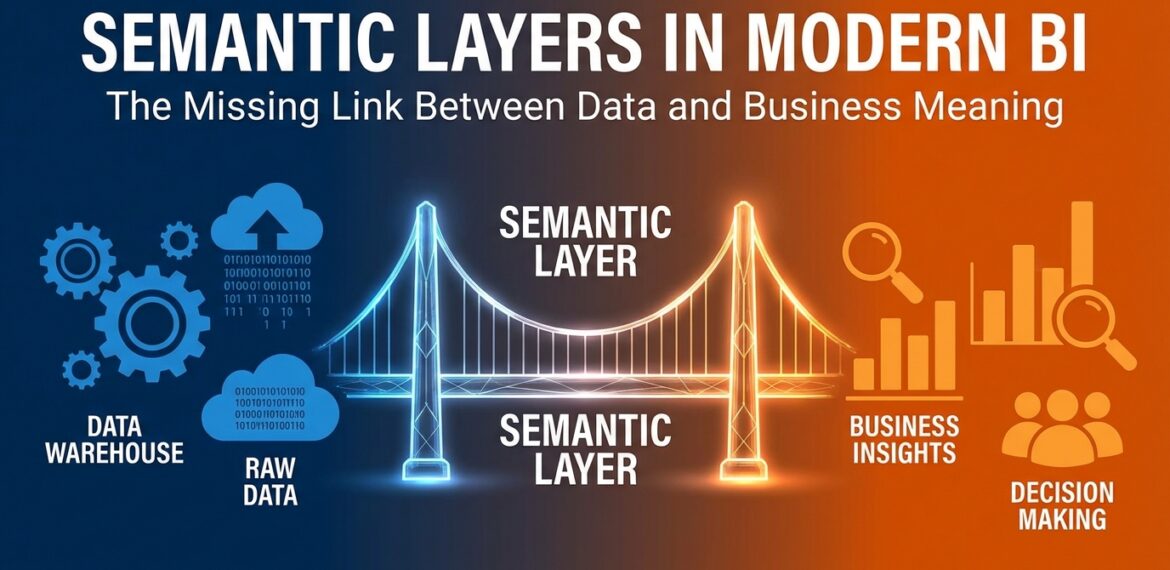
A semantic layer acts as a translation bridge between complex data models and business-friendly definitions. It ensures that when different users analyze data, they rely on the same agreed-upon logic, terminology, and calculations. In modern BI ecosystems, the semantic layer is becoming the backbone of metric consistency and scalable self-service analytics.
Why Data Alone Is Not Enough
Modern data platforms store enormous volumes of information across warehouses, lakes, and streaming systems. But raw data does not automatically translate into meaningful insight.
Tables may contain hundreds of columns. Metrics may require multi-step calculations. Business logic may depend on conditional rules and filters. Without a standardized layer that defines these relationships, each analyst ends up interpreting the data independently.
Over time, this creates:
-
Metric inconsistencies
-
Duplicate calculations
-
Conflicting reports
-
Increased maintenance overhead
-
Reduced trust in analytics
The semantic layer addresses this gap by separating technical data structures from business logic.
What Is a Semantic Layer?
A semantic layer is a centralized, reusable framework where business metrics, dimensions, relationships, and definitions are defined once and shared across all BI tools and reports.
Instead of embedding calculations inside individual dashboards, organizations define them at the semantic level. For example:
-
Revenue is defined consistently across all reports
-
Customer lifetime value uses a single calculation model
-
Churn follows a standardized definition
-
Date logic is uniform across analyses
This ensures that every user accesses the same “version of truth.”
How Semantic Layers Support Self-Service BI
Self-service analytics empowers business users to explore data independently. However, without guardrails, self-service can create chaos.
A semantic layer provides structure without restricting exploration. Users can build their own dashboards and queries, but they do so using standardized metrics and definitions.
This reduces reliance on central BI teams while maintaining consistency and governance.
The Role of Semantic Layers in Modern Data Architectures
As organizations adopt data lakes, lakehouses, and multi-cloud environments, complexity increases. Multiple tools may access the same underlying datasets.
Without a semantic layer, each tool may interpret data differently. With a centralized semantic model, consistency extends across platforms – ensuring alignment even in distributed architectures.
This is particularly important in environments where:
-
Multiple BI tools coexist
-
Data is shared across domains
-
Embedded analytics is deployed in applications
-
AI models depend on consistent feature definitions
The semantic layer becomes the stabilizing force.
Why Metric Governance Depends on Semantics
Metric governance often fails because definitions are buried inside code, dashboards, or informal documentation. When metrics are defined centrally in a semantic layer, governance becomes enforceable rather than advisory.
Changes to a KPI are version-controlled. Stakeholders are notified. Downstream reports update automatically. The risk of silent metric drift decreases significantly.
This level of control strengthens executive confidence in enterprise reporting.
Benefits of Implementing a Semantic Layer
Organizations that invest in semantic layers often experience several measurable improvements.
First, development cycles accelerate because analysts reuse existing definitions rather than recreating logic.
Second, data quality issues become easier to detect because discrepancies are centralized.
Third, collaboration improves across departments as teams align around shared definitions.
Fourth, onboarding new analysts becomes faster, since business logic is documented and standardized.
Most importantly, trust in analytics grows.
Challenges in Adopting Semantic Layers
Despite the benefits, building a semantic layer requires thoughtful planning.
Common challenges include:
-
Aligning stakeholders on metric definitions
-
Refactoring legacy dashboards
-
Integrating with multiple BI tools
-
Maintaining the semantic model over time
-
Preventing uncontrolled customization
Success depends not only on technology, but on governance and cross-functional collaboration.
Semantic Layers and AI-Driven Analytics
As generative AI becomes embedded in BI platforms, semantic layers gain even more importance.
When users ask natural-language questions, AI models rely on predefined metrics and dimensions. Without a structured semantic layer, AI-generated insights may misinterpret definitions or apply inconsistent logic.
A strong semantic foundation ensures that conversational BI remains accurate, explainable, and aligned with business standards.
The Evolution Toward Headless BI
A growing trend in analytics is “headless BI,” where the semantic layer operates independently from visualization tools. This allows organizations to standardize metrics once and distribute them across dashboards, APIs, and embedded applications.
Headless architectures increase flexibility while preserving consistency – a balance that modern enterprises increasingly require.
How Datahub Analytics Helps Build Semantic Foundations
Datahub Analytics supports enterprises in designing and implementing robust semantic layers aligned with business strategy.
Our approach includes:
-
Identifying critical enterprise KPIs
-
Aligning stakeholders around metric definitions
-
Designing reusable semantic models
-
Integrating semantic layers across BI and analytics tools
-
Establishing governance frameworks for change management
-
Supporting ongoing optimization through managed analytics services
We help organizations move from fragmented metrics to cohesive, trusted insight ecosystems.
Conclusion: Meaning Drives Insight
Data without meaning is noise. In modern enterprises, meaning must be defined, governed, and reused consistently.
Semantic layers provide the missing link between raw data and actionable insight. They enable scalable self-service analytics, strengthen governance, and ensure alignment across teams.
As analytics becomes more decentralized and AI-driven, semantic clarity will become even more critical.
In the end, the most valuable analytics platforms are not the ones that store the most data – but the ones that define it most clearly.



