
Composable BI: The Future of Flexible Enterprise Analytics
Composable BI: The Future of Flexible Enterprise Analytics
 Datahub Analytics Team
Business intelligence is entering a new phase. For years, organizations invested in large BI platforms that promised to serve every reporting and analytics need in one place. That model delivered value, but it also created limits. As data ecosystems became more complex, enterprises found themselves working across cloud warehouses, lakehouses, reverse ETL tools, semantic layers, planning platforms, embedded analytics tools, and AI interfaces. In this environment, a rigid, one-size-fits-all BI approach no longer fits the reality of modern business.
That is why composable BI is gaining attention. Instead of treating analytics as a single monolithic system, composable BI allows organizations to build a more flexible analytics stack using interoperable components. This approach aligns better with how enterprises now manage data, applications, governance, and decision-making across multiple teams and platforms.
Why Traditional BI Models Are Under Pressure
Traditional BI platforms were designed for centralization. Data would be brought into a reporting environment, dashboards would be built there, and users would rely on that platform as the primary interface for insight. While this worked well for a period, it also led to several common problems.
One issue is inflexibility. When all reporting logic, metric definitions, and user experiences are tied too tightly to one tool, it becomes difficult to adapt. A change in business needs often requires rework across dashboards, teams, and workflows.
Another issue is duplication. Different departments often build their own versions of the same metrics in different tools, leading to inconsistencies. This creates confusion, reduces trust, and slows decision-making.
A third challenge is that the modern analytics landscape is no longer dashboard-only. Businesses now need analytics to power operational workflows, customer-facing applications, mobile experiences, AI assistants, and automated decision systems. A monolithic BI layer struggles to support all of that effectively.
What Composable BI Actually Means
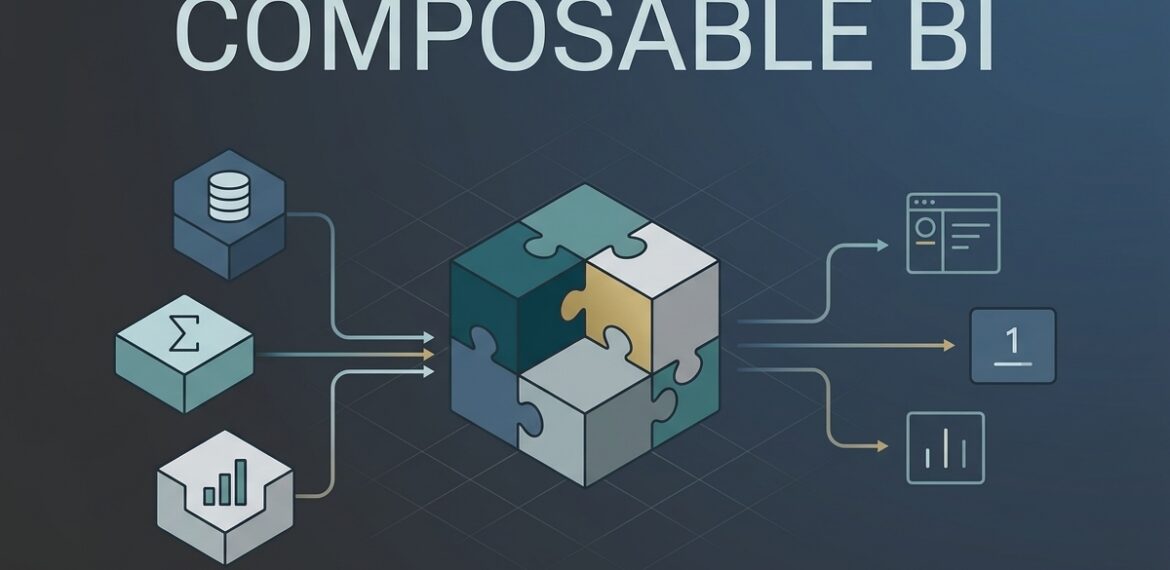
Composable BI is an approach where analytics capabilities are built from modular, connected components rather than locked inside a single platform. These components may include the cloud data warehouse, transformation layer, semantic model, visualization tool, embedded analytics interface, data catalog, governance layer, and AI-powered query experience.
The goal is not to create more complexity for its own sake. The goal is to create flexibility, scalability, and adaptability. Instead of forcing every analytics requirement into one system, composable BI allows organizations to choose the best components for each part of the stack while maintaining consistency through governance and shared business definitions.
In simple terms, composable BI separates the analytics foundation from the user interface. That means metrics, models, and logic can live in governed layers, while different consumption experiences can be tailored for executives, analysts, operational teams, customers, or AI tools.
Why This Trend Is Growing Now
Composable BI is growing because modern enterprises need more flexibility than traditional analytics environments can provide.
First, businesses are now using a wider variety of tools. The analytics stack has expanded significantly. Teams may use one platform for warehousing, another for transformation, another for dashboarding, another for planning, and another for operational activation. In such a setup, forcing all analytics into one closed BI layer often creates friction.
Second, AI is changing how users consume insights. Analytics is no longer just about opening a dashboard and filtering charts. Users want natural language access, context-aware explanations, proactive recommendations, and embedded insights in the tools they already use. A composable setup makes it easier to support these different interfaces without rebuilding core logic each time.
Third, organizations want to reduce vendor lock-in. When business logic is deeply embedded in one tool, switching platforms or expanding capabilities becomes painful. A composable architecture helps protect the enterprise from becoming overly dependent on a single technology provider.
The Role of the Semantic Layer in Composable BI
One of the most important enablers of composable BI is the semantic layer. Without a shared semantic foundation, modularity can quickly turn into chaos.
The semantic layer provides a consistent way to define metrics, dimensions, relationships, and business logic across different analytics tools. This means revenue, margin, churn, customer lifetime value, or conversion rate can be defined once and used consistently across dashboards, applications, and AI interfaces.
This is critical in a composable environment because multiple tools may consume the same data. If each tool defines KPIs differently, the flexibility of the stack becomes a liability instead of an advantage. The semantic layer prevents that by making composability possible without sacrificing trust.
In many ways, the semantic layer is what transforms a collection of tools into a coordinated analytics ecosystem.
How Composable BI Improves Business Agility
One of the biggest advantages of composable BI is agility. When analytics capabilities are modular, organizations can respond more quickly to changing business needs.
For example, if a company wants to launch embedded dashboards for customers, it does not have to redesign its entire BI environment. If a new AI assistant is introduced for natural language analytics, the organization can connect it to the governed semantic and data layers. If finance wants a more tailored planning interface while operations needs real-time performance monitoring, each function can use experiences suited to their needs without breaking metric consistency.
This flexibility is valuable because analytics needs are no longer static. Businesses change quickly. Market conditions shift. New digital channels appear. AI capabilities evolve rapidly. A composable BI architecture makes it easier for analytics to evolve with the business rather than becoming a bottleneck.
Composable BI and the Shift Toward Data Products
Composable BI also fits naturally with the rise of data products. As organizations begin treating data assets as products with ownership, quality standards, and business consumers, they need analytics environments that can distribute those products in multiple ways.
A trusted sales data product, for example, might power executive dashboards, operational alerts, CRM workflows, AI-powered coaching, and customer-facing reports. A monolithic BI model may support part of that need, but a composable model supports the full lifecycle more effectively.
This is one reason why composable BI is becoming more relevant in modern data strategies. It supports the idea that analytics should not be limited to static reporting. Instead, analytics capabilities should be reusable, portable, and available wherever decisions are being made.
Where Enterprises See the Most Value
Composable BI tends to deliver the most value in organizations that are already dealing with analytics complexity.
Large enterprises often operate across multiple geographies, functions, and systems. They may have separate needs for corporate reporting, self-service analytics, partner portals, embedded customer insights, and AI-driven decision support. In these environments, a composable approach can reduce bottlenecks and allow more tailored experiences without losing governance.
Fast-growing companies also benefit because they are less likely to want all their future analytics locked into one tool. A modular architecture gives them room to scale, experiment, and adapt as the business matures.
Even mid-sized organizations can benefit when they want to modernize incrementally. Instead of replacing everything at once, they can improve one layer at a time, such as introducing a better semantic model, modernizing data visualization, or adding embedded analytics capabilities without rebuilding the entire stack.
Common Mistakes in Composable BI Adoption
Despite its promise, composable BI is not automatically successful. Some organizations misunderstand what composability requires.
One mistake is focusing only on tools while ignoring governance. A modular stack without strong governance often leads to fragmented analytics rather than better analytics.
Another mistake is assuming composable BI means every team can use any tool in any way. True composability still needs structure. It requires shared definitions, access controls, metadata standards, and clear architectural principles.
A third mistake is overengineering the environment. The purpose of composable BI is to make analytics more adaptable, not to create unnecessary architectural complexity. Enterprises need to choose modularity where it creates real value, not simply because it sounds modern.
The best composable strategies are disciplined. They combine flexibility with standardization.
How to Start with a Composable BI Strategy
The smartest way to begin is not by chasing every new tool. It starts with identifying where the current BI setup is causing friction.
In some companies, the main problem is inconsistent metrics. In others, it is slow dashboard delivery. In others, it is the inability to support embedded analytics or AI-driven experiences. These pain points help determine where composability will create the most immediate benefit.
A practical starting point may include centralizing business definitions in a semantic layer, strengthening data modeling in the warehouse, and then allowing multiple consumption layers to connect to that governed core. This creates a more stable base for future expansion.
From there, organizations can modernize step by step. They do not need to rebuild everything at once. They need to create a structure where each improvement strengthens the whole analytics ecosystem.
What This Means for the Future of BI
The future of BI is not about abandoning dashboards. It is about placing dashboards in a broader, more flexible analytics architecture.
In the years ahead, business intelligence will increasingly be consumed across many touchpoints. Some users will still rely on dashboards. Others will interact through applications, embedded experiences, alerts, copilots, and AI agents. Enterprises that want to support all of these effectively will need analytics foundations that are modular, governed, and adaptable.
That is why composable BI matters. It reflects the reality of modern enterprise analytics. It allows organizations to move beyond rigid BI stacks and toward ecosystems that are better aligned with business change, digital growth, and AI-ready operations.
How Datahub Analytics Can Help
At Datahub Analytics, we help organizations modernize their analytics environments for flexibility, trust, and long-term scalability. That includes modern data warehouse design, business intelligence transformation, semantic consistency, data governance, and AI-ready analytics architecture.
If your organization is struggling with fragmented dashboards, inconsistent KPIs, tool sprawl, or difficulty supporting new analytics use cases, composable BI offers a practical path forward. The right approach is not to add more complexity. It is to create a stronger foundation where analytics can evolve with your business.



