
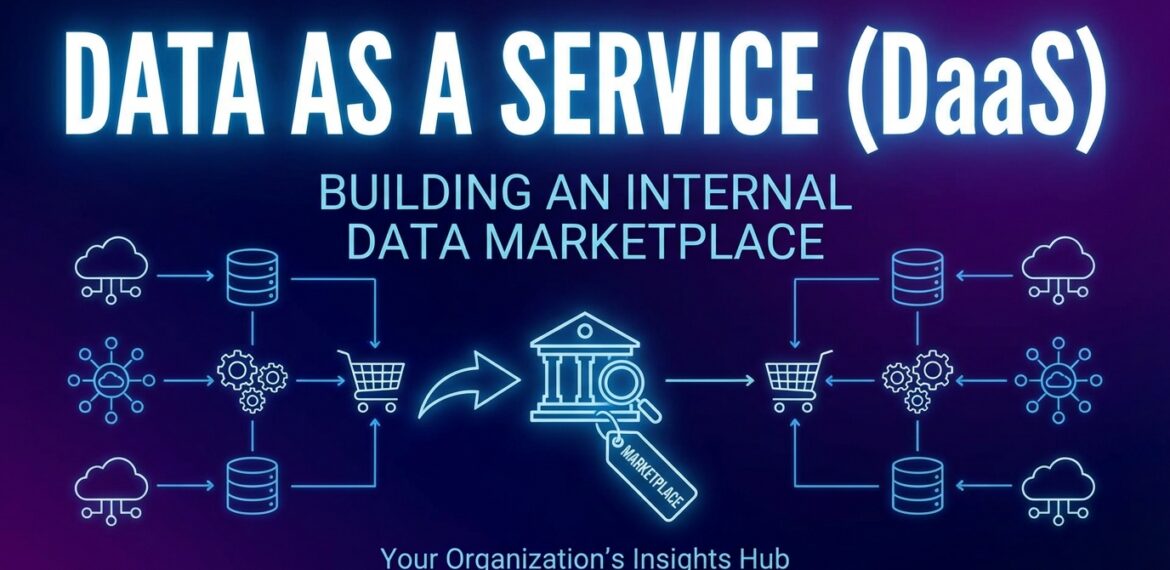
Data as a Service (DaaS): Building an Internal Data Marketplace
Data as a Service (DaaS): Building an Internal Data Marketplace
 Datahub Analytics Team
Enterprises today generate more data than ever before. Yet in many organizations, access to that data remains slow, fragmented, and dependent on central IT or analytics teams. Business users wait for datasets. Analysts rebuild pipelines that already exist. Teams duplicate effort simply because they cannot discover or trust available data.
This inefficiency is driving the rise of Data as a Service (DaaS) within enterprises. Instead of treating data access as an ad-hoc request process, organizations are building internal data marketplaces – platforms where curated, trusted datasets are discoverable, governed, and reusable.
The shift is subtle but powerful. Data moves from being a backend resource to becoming a structured, service-oriented asset.
What Data as a Service Means Internally
Externally, DaaS refers to delivering data products to customers through APIs or subscriptions. Internally, the concept is similar but focused on empowering teams.
An internal DaaS model means:
-
Curated datasets are published as reusable assets
-
Data ownership is clearly defined
-
Access is standardized and governed
-
SLAs define freshness and reliability
-
Usage is monitored and measured
Rather than building pipelines from scratch, teams “consume” data services just as they would consume APIs or cloud infrastructure.
Why Organizations Need an Internal Data Marketplace
As analytics matures, central data teams often become bottlenecks. Every new report or project requires data extraction, modeling, validation, and documentation. This slows innovation and frustrates business teams.
An internal data marketplace solves this by making high-quality datasets discoverable and ready for use. Instead of asking, “Can someone build this dataset for me?”, teams can search, request access, and start working immediately.
This model improves agility while maintaining governance.
The Core Components of an Internal DaaS Model
Building an internal data marketplace requires more than a catalog. It involves multiple layers working together.
First, there must be a curated data layer – datasets modeled, cleaned, and validated for reuse.
Second, there must be a catalog or discovery platform where users can search, filter, and understand data assets.
Third, there must be clear ownership and SLAs, defining responsibility for quality and updates.
Fourth, there must be access controls and governance frameworks to ensure compliance and security.
Finally, there must be usage analytics, helping organizations measure adoption and optimize investments.
Together, these elements turn data into a consumable service.
How DaaS Reduces Redundancy and Inconsistency
In traditional environments, different teams often rebuild similar datasets independently. Marketing creates its own customer segmentation table. Finance calculates revenue slightly differently. Operations extracts its own performance metrics.
An internal DaaS model reduces duplication by centralizing trusted data assets. When everyone pulls from the same curated source, metric consistency improves and reconciliation efforts decline.
This strengthens enterprise alignment and reduces wasted effort.
The Cultural Shift Behind DaaS
Adopting a DaaS model requires a mindset change. Data teams move from being report builders to service providers. Business teams move from being requesters to consumers.
Ownership becomes clearer. Data producers are accountable for quality. Consumers provide feedback and influence improvements. Collaboration becomes structured rather than reactive.
This cultural shift is often more important than the technology itself.
DaaS and Data Governance
Governance becomes more manageable in a DaaS environment because datasets are standardized and monitored. Rather than trying to govern hundreds of ad-hoc extracts, organizations govern curated services.
Metadata, lineage tracking, and trust indicators become essential components. Users can see where data originates, how it is transformed, and whether it meets reliability standards.
This transparency increases adoption and reduces risk.
Supporting Self-Service Analytics
Self-service analytics is only effective when users trust and understand the data available to them. An internal DaaS model provides the foundation for this trust.
Instead of navigating complex raw tables, users access business-ready datasets with clear definitions. This accelerates exploration while maintaining control over sensitive data.
It also allows analytics teams to focus on higher-value work rather than repetitive data preparation.
Challenges in Building an Internal Data Marketplace
Despite its advantages, building a DaaS capability is not trivial.
Organizations often struggle with:
-
Identifying which datasets to prioritize
-
Defining ownership across domains
-
Avoiding over-centralization
-
Encouraging adoption among business users
-
Balancing agility with governance
A phased approach – starting with high-impact domains – often works best.
How DaaS Supports Modern Architectures
Internal DaaS aligns well with modern cloud-native architectures, data lakehouses, and domain-oriented data strategies. It complements concepts like data products and data mesh by providing a practical mechanism for sharing data across domains.
As organizations adopt AI and advanced analytics, having trusted, reusable datasets becomes even more critical. DaaS ensures that these initiatives are built on stable foundations.
How Datahub Analytics Helps Enable Data as a Service
Datahub Analytics helps enterprises design and implement internal data marketplace models tailored to their structure and goals.
Our approach includes:
-
Identifying high-value reusable datasets
-
Designing curated data layers
-
Implementing metadata and discovery platforms
-
Defining ownership and SLAs
-
Integrating governance frameworks
-
Supporting adoption through managed analytics services
We focus on building sustainable ecosystems – not just technical solutions.
Conclusion: From Data Access to Data Service
As enterprises scale their analytics efforts, simply storing and processing data is no longer enough. Organizations must ensure that data is discoverable, trustworthy, and reusable.
Data as a Service provides a structured way to achieve this. By treating data as a service rather than a byproduct, enterprises unlock faster innovation, stronger governance, and greater business impact.
In the future of analytics, the most successful organizations will not just manage data. They will deliver it – clearly, reliably, and at scale.



