
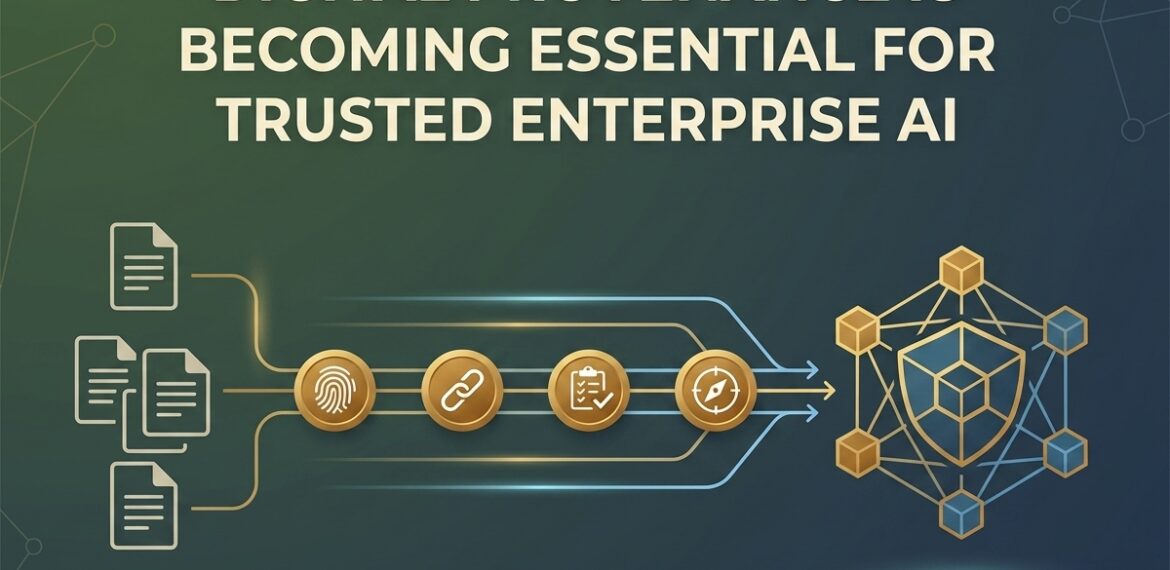
Digital Provenance Is Becoming Essential for Trusted Enterprise AI
Digital Provenance Is Becoming Essential for Trusted Enterprise AI
 Datahub Analytics Team
Enterprise AI is moving deeper into real business workflows, and that is changing what trust means. For years, trust in analytics was mostly about data quality, dashboard accuracy, and governance. In 2026, that conversation is expanding. Enterprises increasingly need to verify where software, data, and AI-generated content came from, how it changed, and whether it can be trusted in operational use. Gartner’s Top Strategic Technology Trends for 2026 includes digital provenance as a key trend, describing it as a way to verify the origin and integrity of software, data, and AI-generated content for trust and compliance.
This matters because AI systems are now generating summaries, recommendations, code, content, and decisions that influence business outcomes. At the same time, enterprises are trying to scale agentic AI, embedded automation, and AI-assisted workflows across finance, supply chain, HR, customer service, and other sensitive functions. Recent reporting on SAP’s new autonomous enterprise push shows just how quickly AI is being woven into core enterprise processes. As that happens, verifying what content is authentic, what data is approved, and what outputs can be relied on becomes a business requirement rather than a technical preference.
Why Trust Is Becoming Harder to Maintain
The more AI an organization uses, the harder it becomes to rely on assumptions.
A report, dataset, or piece of content may look legitimate while hiding important questions. Where did it come from. Was it altered. Was it generated by AI. Which source system produced it. Which transformation changed it. Was it approved for this use case. In traditional BI environments, these questions already mattered. In AI-enabled environments, they matter much more because the volume of machine-generated and machine-transformed content is increasing rapidly. Gartner’s 2026 data and analytics predictions emphasize the growing role of AI across analytics, governance, and enterprise context, while Strategy’s 2026 enterprise trends research says fragmentation and semantic inconsistency are still stalling AI adoption.
This creates a serious trust gap. If an AI system produces a recommendation based on unclear sources, or if enterprise content is reused without clear provenance, then business users may lose confidence quickly. Even worse, the business may act on unreliable outputs without realizing it. That is why digital provenance is gaining attention as a practical trust layer for enterprise AI and analytics.
What Digital Provenance Actually Means
Digital provenance is the ability to verify the origin, integrity, and history of digital assets. In an enterprise setting, that can apply to software, datasets, documents, AI-generated outputs, model artifacts, and operational content.
In simple terms, digital provenance answers questions such as where something came from, whether it was modified, whether its source is trusted, and whether its history can be traced. Gartner’s 2026 technology trend framing makes this especially relevant for software, data, and AI-generated content, which together form a large part of the modern enterprise technology environment.
This idea overlaps with data lineage and data provenance practices already familiar in data management. Snowflake’s explanation distinguishes lineage as the flow and transformation path of data, while provenance focuses more on origin and history. In practice, enterprises increasingly need both. They need to know not only how data moved, but also where it originated and whether it should be trusted in AI and analytics contexts.
Why This Trend Is Accelerating in 2026
One reason is the rise of agentic and autonomous enterprise systems. When AI systems only draft low-risk content, provenance is useful. When AI systems begin influencing workflows, recommendations, and decisions, provenance becomes much more important. Reuters and other recent reporting show that enterprise software vendors are now pushing AI more deeply into business operations, which increases the need for verification and trust controls.
Another reason is the growing focus on secure and auditable AI execution. Recent reporting on confidential AI shows that enterprises are no longer concerned only with model performance. They also want proof that sensitive data was protected during processing, especially in regulated and high-assurance environments. That broader push toward verifiable AI behavior supports the rise of digital provenance as well.
A third reason is that governance expectations are rising while enterprise environments remain fragmented. Strategy’s 2026 enterprise data, AI, and analytics research says many organizations still struggle with inconsistent semantics, fragmented architectures, and limited visibility into how AI uses data. In that kind of environment, provenance becomes more valuable because it adds traceability where trust is otherwise weak.
Why Digital Provenance Matters for Analytics Teams
Digital provenance is not only a security concern. It matters directly to analytics and data leaders.
Modern analytics is expanding beyond static dashboards into conversational BI, AI copilots, decision support, and agent-assisted workflows. In these environments, business users increasingly ask questions that combine structured data, documents, policies, knowledge assets, and AI-generated interpretation. If the organization cannot trace the origin and integrity of those inputs and outputs, trust in the analytics experience will weaken. Gartner’s 2026 technology trend coverage and data-and-analytics predictions both point toward this broader future, where AI and analytics are becoming more tightly connected and more dependent on trustworthy context.
For analytics teams, provenance helps answer practical questions. Which data source fed this metric. Which transformation created this number. Which document informed this AI summary. Was this result derived from an approved and current dataset. Has the content been changed since it was certified. Those are not abstract governance questions. They are central to whether executives, analysts, and operational teams will trust AI-assisted analytics at scale.
The Connection Between Digital Provenance and Data Governance
Digital provenance strengthens governance by making trust more verifiable.
Many organizations already have governance policies, stewardship roles, and quality rules. Those are important, but they often stop short of proving the origin and integrity of digital assets in day-to-day operations. Gartner’s guidance on data governance emphasizes accountability, quality, lifecycle management, and compliance as core foundations. Digital provenance supports those goals by making it easier to trace how content, data, and software were created and used.
This is especially relevant in AI-heavy environments. As AI-generated content becomes more common, governance can no longer rely only on manual trust. Enterprises need ways to verify whether outputs are approved, whether source data is trustworthy, and whether machine-generated artifacts can be distinguished from human-authored or externally sourced material when necessary. That is why provenance is becoming a more practical governance capability, not just a theoretical one.
Where Digital Provenance Creates the Most Business Value
One major use case is AI-generated enterprise content. If organizations are using AI to generate summaries, reports, documentation, or customer-facing material, provenance helps show what was AI-generated, what sources informed it, and whether it has been altered since creation. Gartner explicitly links digital provenance to AI-generated content trust.
Another strong use case is regulated analytics and reporting. In environments where financial, compliance, or operational reports depend on multiple systems and transformations, provenance improves traceability and audit readiness. Lineage helps show movement and transformation, while provenance adds clarity around origin and historical integrity.
Software and model supply chains are another obvious area. As enterprises deploy more AI systems, trust increasingly depends on knowing where models, prompts, code artifacts, and supporting data assets came from. Gartner’s framing of digital provenance covers software as well as data and AI-generated content, reflecting how broad this need is becoming.
Why Provenance Supports Better Enterprise AI Confidence
Many organizations are not blocked from AI because of lack of interest. They are blocked because they do not fully trust what the system is using or producing.
That hesitation grows when AI outputs affect sensitive business processes. A user may ask whether an answer came from an approved policy. A compliance leader may ask whether a generated summary used current source material. A security team may ask whether a model artifact or data asset has been tampered with. Provenance does not solve every AI trust problem, but it does help answer these questions with greater confidence. That is one reason Gartner is elevating it as a strategic trend for 2026.
In practical terms, provenance can help enterprises move from assumed trust to evidence-based trust. That is increasingly important as AI becomes more embedded in workflows and as business stakeholders expect stronger proof that systems are using approved, reliable inputs.
Common Mistakes Companies Make
One common mistake is assuming lineage alone is enough. Lineage is essential, but provenance adds a different layer by focusing more explicitly on origin, authorship, and historical integrity. Enterprises often need both to build stronger trust.
Another mistake is treating digital provenance as only a cybersecurity topic. It is also an analytics, governance, and AI adoption topic because business users need trusted outputs, not just secure infrastructure. Gartner’s 2026 trend framing makes clear that provenance spans software, data, and AI-generated content.
A third mistake is trying to apply provenance everywhere without prioritization. The best early candidates are usually high-value, high-risk use cases such as regulated reporting, AI-generated business content, sensitive data workflows, and systems where trust failures would create meaningful business impact.
How to Start with a Digital Provenance Strategy
A practical starting point is to identify where trust questions are already slowing progress. That may be AI-generated reports, sensitive document workflows, regulated analytics, model-driven recommendations, or enterprise content used across multiple teams.
From there, the organization can define what must be verified. That may include source origin, transformation history, approval status, authorship, or whether content was machine-generated. The next step is to connect provenance efforts with existing lineage, governance, metadata, and security practices rather than treating it as a separate initiative. That integrated approach is more likely to create real business value.
How Datahub Analytics Can Help
At Datahub Analytics, we help organizations build trusted analytics and AI foundations that support stronger governance, clearer traceability, and more reliable decision-making. That includes modern data architecture, business intelligence modernization, semantic consistency, governance frameworks, and AI-ready data environments.
If your organization is exploring AI-driven reporting, agentic workflows, or enterprise knowledge systems but facing concerns about trust, traceability, or approval control, digital provenance should be part of the conversation. The goal is not just to produce more intelligence. It is to make that intelligence verifiable, governed, and dependable.
Conclusion
Digital provenance is becoming essential because enterprise AI is making trust more complex. As organizations rely on software, data, and AI-generated content in more business-critical workflows, they need stronger ways to verify origin, integrity, and history. Gartner’s inclusion of digital provenance in its 2026 strategic technology trends reflects how important this has become for trust and compliance.
The next phase of enterprise analytics and AI will not be defined only by smarter models or faster outputs. It will also be defined by whether organizations can prove what those systems are using and producing. Enterprises that build strong provenance into their data and AI foundations will be better positioned to scale innovation with confidence, governance, and trust.



