
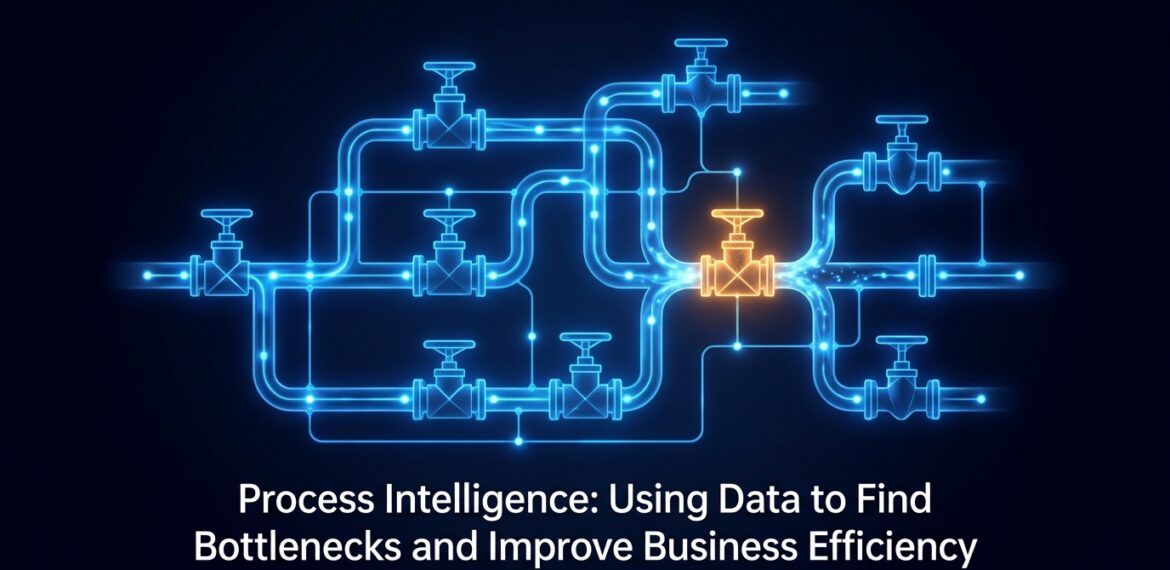
Process Intelligence: Using Data to Find Bottlenecks and Improve Business Efficiency
Process Intelligence: Using Data to Find Bottlenecks and Improve Business Efficiency
 Datahub Analytics Team
Every organization has processes that look simple on paper but become complex in reality.
A customer request moves through multiple teams. An invoice passes through approvals. A sales opportunity goes through follow-ups, proposals, negotiations, and handovers. A purchase order moves between procurement, finance, suppliers, and operations. A service ticket may travel across support, technical teams, supervisors, and account managers.
Each process creates data.
But many businesses still do not have a clear view of how these processes actually work. They may know the final outcome, but not the delays, rework, manual steps, hidden exceptions, or repeated inefficiencies along the way.
Process intelligence helps solve this problem.
It uses data to analyze how business processes are really executed. It helps organizations identify bottlenecks, improve efficiency, reduce manual effort, and create better outcomes across departments.
For businesses looking to improve productivity, automation, customer experience, and cost control, process intelligence can provide a practical path forward.
What Is Process Intelligence?
Process intelligence is the use of data and analytics to understand, monitor, and improve business processes.
It brings together information from systems such as ERP, CRM, finance platforms, ticketing tools, workflow systems, HR applications, procurement systems, and operational databases. This data is then used to analyze how work moves across the organization.
The goal is to answer important questions:
Where are processes slowing down?
Which steps create the most delays?
Where is manual work repeated?
Which approvals take too long?
Where are errors happening?
Which teams are overloaded?
Which processes should be automated first?
By answering these questions, process intelligence gives businesses a clearer view of operational reality.
From Assumptions to Evidence
Many process improvement discussions are based on assumptions.
One team may believe delays happen because approvals are slow. Another team may blame missing documents. A manager may think the issue is staffing. Employees may point to system limitations.
Process intelligence replaces guesswork with evidence.
It uses real process data to show where time is spent, where work gets stuck, where exceptions occur, and which activities create unnecessary effort.
This helps teams focus on the real causes of inefficiency.
Seeing the Actual Process, Not Just the Designed Process
Most businesses have documented processes. But the way work is documented is often different from the way work actually happens.
A process may be designed with five steps, but in reality, it may involve ten steps, multiple rework loops, manual checks, email follow-ups, spreadsheet updates, and informal approvals.
Process intelligence reveals the actual path work takes.
This helps organizations understand process variations and identify opportunities for simplification.
Why Process Intelligence Matters
Businesses are under pressure to do more with less.
They need faster service, lower costs, better compliance, improved productivity, and smoother customer experiences. But without process visibility, improvement efforts can become slow and fragmented.
Process intelligence helps organizations improve operations with better data.
Manual Work Reduces Productivity
Many employees spend time on repetitive tasks that could be improved or automated.
This may include copying data between systems, checking forms, preparing reports, sending reminders, validating documents, following up on approvals, or reconciling information.
Process intelligence helps identify where this manual effort is happening.
Once these areas are visible, businesses can decide whether to redesign the process, improve system integration, automate tasks, or introduce better dashboards.
Delays Affect Customer Experience
Customers may not see internal process steps, but they feel the impact.
A delayed approval can slow service delivery. A missed handover can affect response time. A manual error can create frustration. A slow onboarding process can reduce customer satisfaction.
Process intelligence helps businesses identify where internal delays affect external experience.
This is especially important for sectors such as banking, telecom, healthcare, logistics, government services, insurance, and enterprise support.
Inefficient Processes Increase Cost
Every delay, manual correction, duplicate task, and unnecessary approval adds cost.
These costs may not always appear clearly in financial reports, but they affect productivity and profitability.
Process intelligence helps organizations understand the hidden cost of inefficient workflows.
This supports better cost control and resource planning.
Automation Needs the Right Starting Point
Many organizations want to use Robotic Process Automation and workflow automation, but they are not always sure where to begin.
Automating the wrong process can create limited value.
Process intelligence helps identify the best automation opportunities by showing which processes are repetitive, rule-based, high-volume, and time-consuming.
This makes automation more targeted and effective.
Key Areas Where Process Intelligence Creates Value
Process intelligence can support many departments and business functions. Its value is strongest in processes that involve multiple systems, repeated handoffs, manual effort, or frequent delays.
Finance and Invoice Processing
Finance teams often manage invoice approvals, payment processing, expense reviews, reconciliations, procurement checks, and reporting cycles.
Process intelligence can show where invoices get delayed, which approval steps take too long, where exceptions occur, and how much manual effort is involved.
This can help finance teams reduce cycle time, improve control, and identify automation opportunities.
Procurement and Purchase Orders
Procurement processes often involve requests, vendor selection, approvals, purchase orders, delivery confirmation, invoice matching, and payment coordination.
Delays in procurement can affect operations, inventory, project timelines, and supplier relationships.
Process intelligence helps businesses monitor procurement cycle time, approval bottlenecks, supplier delays, and process exceptions.
Customer Service and Support
Customer support processes generate large amounts of data.
Tickets may move between agents, departments, technical teams, supervisors, and escalation paths. Some issues are resolved quickly, while others remain open for too long.
Process intelligence can reveal where support tickets get stuck, which issue types take longer, which teams are overloaded, and where repeat complaints occur.
This helps improve service quality and customer experience.
Sales Operations
Sales processes involve lead qualification, follow-ups, proposals, pricing approvals, contract review, negotiations, and handover to delivery or customer success teams.
Process intelligence can help sales leaders understand where deals slow down, which approval steps delay closure, which opportunities require repeated follow-up, and where handoffs are weak.
This improves pipeline execution and revenue performance.
Employee Onboarding
Employee onboarding often requires coordination between HR, IT, finance, facilities, managers, and compliance teams.
If the process is slow or inconsistent, new employees may face delays in access, equipment, training, or role readiness.
Process intelligence can help organizations identify onboarding delays and improve the employee experience.
IT Service Management
IT service processes include incident handling, access requests, change approvals, system issues, asset provisioning, and user support.
Process intelligence can show resolution time, escalation patterns, recurring incidents, approval delays, and workload distribution.
This helps IT teams improve service delivery and operational reliability.
Order-to-Cash
The order-to-cash process connects sales, order management, delivery, billing, collections, and finance.
Delays or errors in this process can affect revenue recognition, cash flow, customer satisfaction, and operational efficiency.
Process intelligence helps businesses track orders from creation to payment and identify where revenue or cash flow is being delayed.
The Data Foundation for Process Intelligence
Process intelligence depends on accurate and connected data.
A business process usually crosses multiple systems and teams. If data is fragmented, the process view will be incomplete.
Connecting Process Data Across Systems
Process data may come from ERP, CRM, ticketing systems, workflow platforms, finance tools, HR applications, emails, spreadsheets, and custom applications.
To understand the full process, organizations need to connect these data sources.
For example, an invoice process may involve procurement data, supplier data, approval workflow data, finance data, and payment data. Looking at only one system will not reveal the full process journey.
Modern Data Warehouse as the Process Analytics Foundation
A modern data warehouse can bring process data into one structured environment.
It allows organizations to combine events, timestamps, users, departments, cases, transactions, and outcomes. This creates a foundation for process dashboards, performance analysis, automation planning, and advanced analytics.
Without a strong data foundation, process intelligence may remain limited to isolated reports.
Event Data and Timestamps
Process intelligence depends heavily on event data.
Each step in a process should ideally have a timestamp, status, owner, system source, and case identifier. This makes it possible to analyze cycle time, waiting time, handoffs, rework, and exceptions.
For example, in an invoice process, useful events may include invoice received, invoice validated, approval requested, approval completed, exception raised, payment scheduled, and payment completed.
These events help reconstruct the actual process flow.
Business-Ready Process Models
Data should be modeled around processes and business entities.
This may include invoices, purchase orders, service tickets, sales opportunities, customer requests, employee cases, applications, claims, orders, and payments.
When process data is structured clearly, dashboards and analysis become easier to use.
Using BI and Dashboards for Process Visibility
Business intelligence plays an important role in process intelligence.
Dashboards can help teams monitor process performance, identify delays, and track improvement over time.
Process Performance Dashboards
A process performance dashboard may show volume, cycle time, waiting time, completion rate, backlog, exception rate, rework rate, and SLA performance.
These metrics help managers understand whether the process is working efficiently.
The dashboard should highlight where attention is needed rather than only showing totals.
Bottleneck Analysis
Bottleneck analysis shows where work gets stuck.
For example, an approval step may take five times longer than other steps. A specific team may have a high backlog. A particular document type may require repeated correction.
By identifying bottlenecks, businesses can prioritize improvements more effectively.
Exception Monitoring
Exceptions often create hidden workload.
A process may run smoothly for standard cases, but exceptions may require manual review, emails, corrections, escalations, or additional approvals.
Dashboards can help track exception types, frequency, impact, and resolution time.
Reducing exceptions can improve efficiency significantly.
Team and Department Views
Different teams need different process views.
Executives may need high-level process health. Managers may need team-level performance. Frontline users may need case-level detail. Analysts may need drill-down capabilities.
Role-based dashboards make process intelligence more useful across the organization.
How Data Science Improves Process Intelligence
Data science can help process intelligence move from monitoring to prediction and optimization.
Predicting Process Delays
Predictive models can estimate which cases are likely to be delayed based on historical patterns.
For example, an invoice may be at risk of delay if it has missing information, a specific supplier, a high value, or a history of approval exceptions.
This allows teams to act earlier.
Identifying Root Causes
Data science can help identify factors that contribute to delays, errors, rework, or customer dissatisfaction.
Instead of looking only at symptoms, businesses can understand the drivers behind process problems.
This supports more effective improvement.
Prioritizing Workloads
AI and machine learning can help prioritize cases based on risk, value, urgency, or expected impact.
For example, high-value customer requests, urgent finance exceptions, critical support tickets, or revenue-impacting delays can be prioritized automatically.
This improves resource allocation.
Optimizing Process Design
Advanced analytics can compare different process paths and identify which ones perform better.
Businesses can use this insight to redesign workflows, simplify approvals, remove unnecessary steps, or improve handoffs.
Process Intelligence and RPA
Process intelligence and Robotic Process Automation work well together.
Process intelligence helps identify where automation should be applied. RPA helps execute repetitive tasks.
Finding the Best Automation Candidates
Not every process should be automated.
The best RPA candidates are usually high-volume, repetitive, rule-based, stable, and manual. Process intelligence helps identify these candidates using actual data.
This improves the success rate of automation projects.
Reducing Manual Data Entry
Many business processes still require employees to copy data between systems, update records, check forms, or prepare reports.
RPA can automate these tasks when the rules are clear.
Process intelligence helps quantify the effort involved and measure the impact after automation.
Monitoring Automation Performance
After automation is implemented, process intelligence can track whether performance improves.
It can show reduced cycle time, fewer errors, lower backlog, improved SLA performance, and reduced manual effort.
This helps businesses measure automation ROI.
Combining Human and Digital Workflows
Some processes cannot be fully automated.
They may require human judgment, approvals, customer interaction, or exception handling. In these cases, process intelligence helps design the right balance between human work and digital automation.
This creates more practical automation outcomes.
Infrastructure Requirements for Process Intelligence
Process intelligence needs reliable data pipelines, scalable processing, and strong integration capabilities.
Data Integration Infrastructure
Since process data often comes from multiple systems, integration is critical.
Organizations need pipelines that can extract, transform, and combine data from applications, databases, logs, workflow tools, and business systems.
This creates the foundation for end-to-end process visibility.
Scalable Data Processing
Large organizations may process thousands or millions of process events every day.
Big data infrastructure can help manage this volume efficiently.
This is especially important for businesses with high transaction volumes, large customer bases, or complex operational workflows.
Hybrid Cloud Support
Many process systems may exist across cloud and on-premise environments.
A hybrid cloud approach can help organizations connect legacy systems with modern analytics platforms without disrupting existing operations.
This is important for enterprises that depend on ERP, finance, HR, or industry-specific systems.
DevOps and Containerized Deployment
Process intelligence solutions need continuous improvement.
New process steps may be added. Dashboards may evolve. Automation workflows may change. Data models may need updates.
DevOps practices and containerized infrastructure help manage these changes more reliably.
Managed Infrastructure Services
As analytics and automation environments grow, infrastructure management becomes more complex.
Managed infrastructure services can help monitor performance, manage workloads, maintain availability, and reduce operational burden.
This allows internal teams to focus on process improvement and business value.
Common Mistakes in Process Intelligence Projects
Process intelligence can create strong value, but only when designed around real business needs.
Starting with Technology Instead of Process Pain
Businesses should not begin with a tool and then search for a problem.
They should start with clear process pain points such as delays, manual work, rework, customer complaints, high cost, or poor visibility.
The technology should support the business problem.
Ignoring the Actual User Experience
A process may look efficient in a system, but employees may still rely on emails, spreadsheets, phone calls, or manual checks.
Process intelligence should include how work actually happens, not only what the system records.
Looking at One Department Only
Many processes cross departments.
If each department analyzes only its own part, the organization may miss the full bottleneck.
A delay may start in sales, continue in finance, and affect customer service. End-to-end visibility is important.
Automating Broken Processes
Automation should not be used to speed up a poorly designed process without review.
If a workflow has unnecessary approvals, duplicate checks, or unclear ownership, businesses should improve the process before or during automation.
Otherwise, automation may simply make inefficiency faster.
Not Measuring Improvement
Process intelligence should track before-and-after performance.
Businesses should measure cycle time, cost, error rates, backlog, SLA performance, customer impact, and employee effort.
This helps demonstrate value and guide continuous improvement.
A Practical Roadmap for Process Intelligence
Organizations can build process intelligence step by step. The best approach is to start with one high-impact process and expand gradually.
Choose a Process with Clear Business Impact
Start with a process that affects cost, revenue, customer experience, compliance, or productivity.
Good candidates include invoice processing, customer support, procurement, order-to-cash, sales approvals, employee onboarding, or IT service management.
Map the Process and Systems
Identify the steps, teams, systems, data sources, handoffs, approvals, exceptions, and outputs.
This helps define what data is needed and where it comes from.
Collect and Connect Event Data
Extract the process events from relevant systems.
This may include timestamps, statuses, owners, case IDs, activity names, departments, and outcomes.
The data should be connected into a structured process model.
Build Process Dashboards
Create dashboards that show cycle time, bottlenecks, backlog, exceptions, SLA performance, and workload distribution.
The dashboard should be designed for the users who manage the process.
Identify Improvement Opportunities
Use the data to identify delays, repeated manual tasks, rework loops, unnecessary approvals, and automation candidates.
Prioritize improvements based on business value and implementation effort.
Apply Automation Where Suitable
Use RPA or workflow automation for repetitive, rule-based, and high-volume tasks.
Automation should be connected to clear process goals.
Measure and Expand
Track improvement after changes are made.
Once the first process shows value, expand process intelligence to other areas of the business.
How Datahub Analytics Can Help
Datahub Analytics helps organizations use process intelligence to improve efficiency, reduce manual effort, and strengthen business performance.
Through its Datahub Analytics services, the company supports big data analytics, modern data warehouse development, business intelligence, data visualization, data science, and robotic process automation. These capabilities help businesses connect process data, build dashboards, identify bottlenecks, detect exceptions, and automate repetitive workflows.
Datahub Infrastructure supports the technical foundation required for process intelligence through big data infrastructure, containerized infrastructure, DevOps infrastructure solutions, hybrid cloud infrastructure solutions, and managed infrastructure services. This helps organizations build scalable and reliable platforms for process analytics, automation, and operational improvement.
For organizations that need additional expertise or delivery capacity, Datahub Outsourcing provides staff augmentation, AI and ML engineers, managed data analytics, data management, PMO services, and Data & Analytics Centre of Excellence support.
By combining analytics, infrastructure, automation, and skilled delivery teams, Datahub Analytics helps businesses turn process data into practical improvement and measurable efficiency gains.
Conclusion
Process intelligence helps businesses understand how work really happens.
It reveals bottlenecks, delays, rework, manual effort, exceptions, and automation opportunities that are often hidden inside daily operations.
With the right data foundation, dashboards, analytics models, and automation workflows, organizations can improve productivity, reduce costs, speed up service delivery, and create better customer and employee experiences.
For businesses that want to move beyond surface-level reporting and improve the way work gets done, process intelligence is a practical and high-value area for analytics transformation.



