
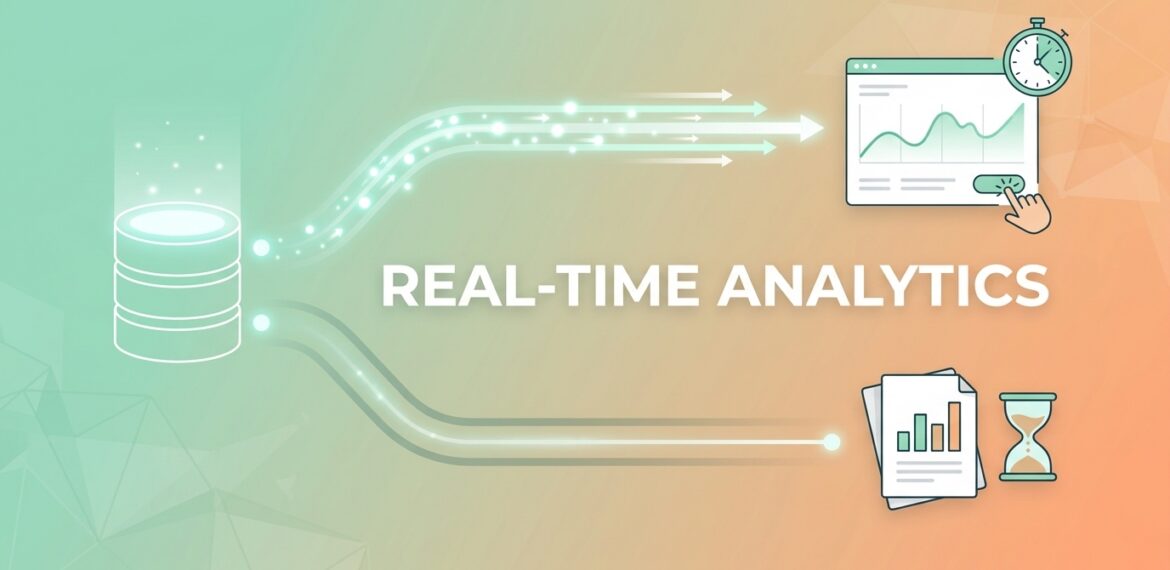
Real-Time Analytics: Helping Businesses Move from Delayed Reports to Faster Decisions
Real-Time Analytics: Helping Businesses Move from Delayed Reports to Faster Decisions
 Datahub Analytics Team
Business decisions lose value when they arrive too late.
Many organizations still depend on weekly reports, monthly summaries, manual dashboards, and spreadsheet-based updates to understand performance. By the time the numbers are reviewed, the situation may have already changed. A sales opportunity may be lost. A customer issue may have escalated. A supply chain delay may have affected delivery. A cost overrun may have gone unnoticed for weeks.
In a fast-moving business environment, delayed insight creates delayed action.
This is why real-time analytics is becoming a priority for organizations that want faster visibility, stronger operational control, and better customer responsiveness. It allows teams to monitor business events as they happen, identify issues earlier, and act before small problems become major disruptions.
Real-time analytics is not only for technology companies. It is relevant for banks, retailers, telecom operators, logistics providers, healthcare organizations, government entities, manufacturers, and service-based enterprises. Wherever speed matters, real-time insight can create measurable business value.
What Real-Time Analytics Means for Modern Businesses
Real-time analytics is the ability to collect, process, analyze, and visualize data with minimal delay. Instead of waiting for scheduled reports, business teams can see what is happening now across systems, departments, customers, products, and operations.
This does not always mean every metric must update every second. For some use cases, near real-time visibility every few minutes may be enough. The real goal is to reduce the gap between business activity and business awareness.
From Historical Reporting to Live Visibility
Traditional reporting helps organizations understand what happened in the past. Real-time analytics helps them understand what is happening now.
This shift is important because many business problems are time-sensitive. Customer complaints, payment failures, delivery delays, system outages, demand spikes, inventory shortages, and suspicious activity all require quick attention.
When businesses rely only on historical reporting, they often discover these issues after the impact has already occurred. With real-time analytics, teams can detect changes earlier and respond faster.
From Manual Monitoring to Automated Alerts
Real-time analytics also reduces the need for manual monitoring.
Instead of asking teams to continuously check dashboards or prepare updates, businesses can configure alerts based on specific conditions. For example, if order failures increase, inventory drops below a threshold, revenue dips suddenly, or customer activity changes sharply, the right team can be notified automatically.
This helps organizations move from passive reporting to active business monitoring.
Why Delayed Data Creates Business Risk
Delayed data may look harmless, but it often creates hidden risk across the organization. When teams do not have current information, they make decisions based on assumptions, outdated reports, or incomplete visibility.
Over time, this affects performance, customer experience, and operational efficiency.
Slow Decisions Reduce Agility
When business leaders wait days or weeks for updated information, they lose the ability to react quickly.
A marketing team may continue spending on a campaign that is underperforming. A sales team may not notice a drop in lead conversion. An operations team may miss early signs of service delays. A finance team may detect cost anomalies too late.
Real-time analytics helps reduce this delay by giving teams earlier signals.
Disconnected Data Creates Blind Spots
In many organizations, different departments operate with different systems. Sales data may sit in a CRM. Finance data may sit in ERP. Customer support data may sit in ticketing platforms. Operations data may sit in logistics or service systems.
When this data is not integrated, teams get partial visibility.
Real-time analytics depends on connected data pipelines that bring information together. This gives decision-makers a more complete view of what is happening across the business.
Where Real-Time Analytics Creates the Most Value
Real-time analytics can support many business functions, but the strongest value often appears in areas where timing directly affects outcomes.
Customer Experience Monitoring
Customer expectations are higher than ever. They expect fast service, smooth digital experiences, accurate updates, and quick issue resolution.
Real-time analytics can help businesses monitor customer journeys across digital channels, service touchpoints, transactions, and support interactions.
For example, an organization can track sudden increases in failed logins, abandoned carts, delayed responses, payment errors, or complaint volumes. These signals can help teams act quickly before customer dissatisfaction grows.
Sales and Revenue Performance
Sales teams need timely visibility into pipeline movement, conversion rates, product performance, and regional trends.
Real-time analytics allows sales leaders to monitor revenue performance throughout the day or week instead of waiting for end-of-month reports. If a region is underperforming, if a product is slowing down, or if a campaign is generating strong demand, managers can respond faster.
This can support better forecasting, better resource allocation, and more focused sales action.
Operations and Service Delivery
Operations teams often deal with fast-changing conditions. Delivery schedules, service requests, stock levels, workforce allocation, and production processes can shift throughout the day.
Real-time analytics helps operations teams identify bottlenecks, delays, exceptions, and capacity issues early.
For logistics, this may mean tracking shipment delays. For manufacturing, it may mean monitoring production line performance. For service businesses, it may mean tracking turnaround time and workload distribution.
Financial and Cost Visibility
Finance teams often depend on periodic reporting cycles. However, real-time or near real-time financial visibility can help organizations monitor revenue, expenses, collections, cash flow indicators, and transaction patterns more effectively.
This does not replace formal financial reporting. Instead, it gives finance and leadership teams faster operational insight into financial performance.
Early visibility into unusual cost movements, payment failures, revenue drops, or collection delays can support better control.
Risk and Anomaly Detection
Real-time analytics is especially useful for identifying unusual patterns.
This may include suspicious transactions, abnormal system usage, unexpected operational changes, unusual customer behavior, or sudden metric deviations.
When paired with data science and machine learning, real-time analytics can help detect anomalies that may not be obvious in standard dashboards. This allows organizations to investigate issues earlier and reduce potential losses.
The Technology Foundation Behind Real-Time Analytics
Real-time analytics requires more than a dashboard. It depends on a strong data architecture that can collect, process, store, and deliver data quickly and reliably.
Data Integration and Streaming Pipelines
The first requirement is data movement.
Organizations need pipelines that can bring data from multiple systems into analytics platforms with minimal delay. This may include APIs, event streaming, database replication, application logs, IoT feeds, and system integrations.
The quality of these pipelines directly affects the quality of real-time analytics. If data is incomplete, delayed, duplicated, or inconsistent, the insights will not be reliable.
Modern Data Warehouse and Lakehouse Architecture
Real-time analytics needs a scalable storage and processing layer.
Modern data warehouses and lakehouse architectures help organizations manage large volumes of structured and semi-structured data. They support faster querying, better integration, and stronger analytics performance.
This foundation allows businesses to combine historical data with live data. That combination is powerful because teams can compare current activity with past patterns, seasonal trends, and expected performance.
Business Intelligence and Visualization Layer
Real-time analytics must be easy for business users to understand.
Dashboards should provide clear visibility into live metrics, trends, exceptions, and alerts. The goal is not to overwhelm users with constantly changing charts. The goal is to highlight what requires attention.
Effective visualization design is critical. Real-time dashboards should focus on priority metrics, operational signals, and decision points.
Infrastructure for Scale and Reliability
Real-time analytics puts pressure on infrastructure. Data must move quickly, queries must run efficiently, and dashboards must stay available.
This requires scalable infrastructure across cloud, hybrid cloud, containers, DevOps, and managed environments. Organizations need architectures that can handle data volume, processing speed, security requirements, and business continuity.
Without strong infrastructure, real-time analytics may become slow, unstable, or difficult to maintain.
Common Mistakes in Real-Time Analytics Projects
Real-time analytics can create strong value, but only when implemented with clear business purpose. Many organizations struggle because they focus too much on technology and not enough on outcomes.
Tracking Everything Instead of What Matters
Not every metric needs real-time monitoring.
A common mistake is trying to make every report real-time. This increases complexity and cost without always improving decisions.
Businesses should identify where speed truly matters. Real-time analytics should focus on metrics that require quick action, such as failures, delays, demand changes, customer issues, operational bottlenecks, or revenue-impacting events.
Building Dashboards Without Action Paths
A real-time dashboard is only useful if someone knows what to do with the insight.
If a metric turns red, who responds? What action should be taken? Is there an escalation process? Should an alert be triggered? Should a workflow start automatically?
Without action paths, real-time dashboards become visual noise.
Ignoring Data Quality
Real-time data must still be trusted.
Speed should not come at the cost of accuracy. If teams see conflicting numbers or unreliable alerts, they will stop using the system.
Organizations need clear data validation, monitoring, reconciliation, and metric definitions to ensure real-time analytics remains dependable.
Underestimating Adoption
Real-time analytics changes how teams work.
Managers may need to shift from periodic review to continuous monitoring. Operations teams may need new response processes. Executives may need new performance views. Business users may need training on how to interpret live metrics.
Adoption planning is essential for success.
How AI Can Strengthen Real-Time Analytics
AI can extend the value of real-time analytics by helping organizations detect patterns, forecast outcomes, and recommend actions faster.
Smarter Anomaly Detection
Traditional dashboards rely on fixed thresholds. For example, if failed transactions exceed a certain number, an alert is triggered.
AI can make this more intelligent by learning normal patterns and detecting unusual behavior based on context. This can reduce false alarms and identify subtle issues earlier.
Predictive Signals
Real-time analytics shows what is happening now. Predictive analytics helps estimate what may happen next.
For example, a business may predict demand spikes, customer churn risk, delivery delays, or system capacity issues based on live and historical data.
This helps teams act before the problem fully develops.
Automated Recommendations
AI can also support next-best-action recommendations.
Instead of only showing that a metric has changed, the system can suggest possible causes or recommended responses. This can help business teams move faster from insight to action.
However, AI works best when the data foundation is strong. Clean data, integrated systems, scalable infrastructure, and well-defined business metrics are still essential.
Real-Time Analytics and Automation Work Better Together
Real-time analytics identifies what is happening. Automation helps execute the response.
When these two capabilities work together, businesses can reduce manual effort and improve response speed.
Automated Alerts and Escalations
If a dashboard detects a critical issue, an automated alert can be sent to the responsible team. If the issue remains unresolved, it can be escalated.
This is useful for operations, customer service, IT, finance, and logistics teams.
Workflow Automation
Real-time signals can also trigger workflows.
For example, if inventory falls below a threshold, a replenishment workflow can begin. If a customer shows churn risk, a retention process can be triggered. If a transaction fails repeatedly, a support case can be created.
This turns analytics into a practical business action system.
Reducing Manual Reporting Effort
Real-time analytics can also reduce the time teams spend preparing status updates.
Instead of manually collecting data and creating reports, teams can rely on automated dashboards and alerts. This improves productivity and allows people to focus on analysis, problem-solving, and decision-making.
A Practical Roadmap for Real-Time Analytics
Businesses do not need to implement real-time analytics everywhere at once. A focused roadmap can deliver value faster and reduce complexity.
Identify Time-Sensitive Business Use Cases
The first step is to identify where delays are hurting performance.
Good starting points include customer experience monitoring, operational delays, sales performance, financial exceptions, inventory visibility, service quality, and anomaly detection.
The best use cases are those where faster action can clearly improve results.
Assess Data Sources and Integration Needs
Next, organizations should review the systems involved.
Which applications generate the data? How frequently does the data update? Is API access available? Are there data quality issues? Does the business need second-by-second visibility or near real-time updates?
These answers shape the technical architecture.
Build the Data Pipeline and Analytics Layer
Once the use case is clear, the organization can design the data pipeline, storage layer, processing logic, and dashboards.
The goal should be to create a scalable foundation that can support additional use cases later.
Design Alerts, Roles, and Actions
A real-time analytics project should define what happens when an issue is detected.
Who receives the alert? What is the expected response? How is the issue tracked? What is escalated? What can be automated?
This step turns real-time visibility into business impact.
Measure Business Value
Finally, organizations should measure the value created.
This may include faster response time, reduced reporting effort, fewer operational delays, improved customer satisfaction, increased revenue visibility, or better cost control.
Real-time analytics should be connected to outcomes, not just technical performance.
How Datahub Analytics Can Help
Datahub Analytics helps organizations design and implement analytics solutions that improve visibility, speed, and decision-making.
Through its Datahub Analytics services, the company supports big data analytics, modern data warehouse development, business intelligence, data visualization, data science, and robotic process automation. These capabilities help businesses move from delayed reporting to timely, actionable insight.
Datahub Infrastructure supports the technology foundation required for real-time analytics through big data infrastructure, containerized infrastructure, DevOps infrastructure solutions, hybrid cloud infrastructure, and managed infrastructure services. This ensures that analytics environments are scalable, reliable, and ready for high-volume data workloads.
For organizations that need additional delivery capacity, Datahub Outsourcing provides staff augmentation, AI and ML engineers, managed data analytics, data management, PMO services, and Data & Analytics Centre of Excellence support.
With the right combination of analytics, infrastructure, automation, and expert teams, Datahub Analytics helps organizations build real-time analytics capabilities that support faster action and measurable business value.
Conclusion
Real-time analytics gives businesses the ability to see important changes earlier and respond with greater confidence.
It helps organizations move beyond delayed reports, manual monitoring, and reactive decision-making. With the right data foundation, visualization layer, infrastructure, and automation strategy, real-time analytics can improve customer experience, operations, revenue visibility, and risk detection.
The most successful organizations will not simply collect more data. They will use timely data to make better decisions at the right moment.
For businesses looking to improve speed, agility, and performance, real-time analytics is a practical step toward a more responsive and data-driven future.



