
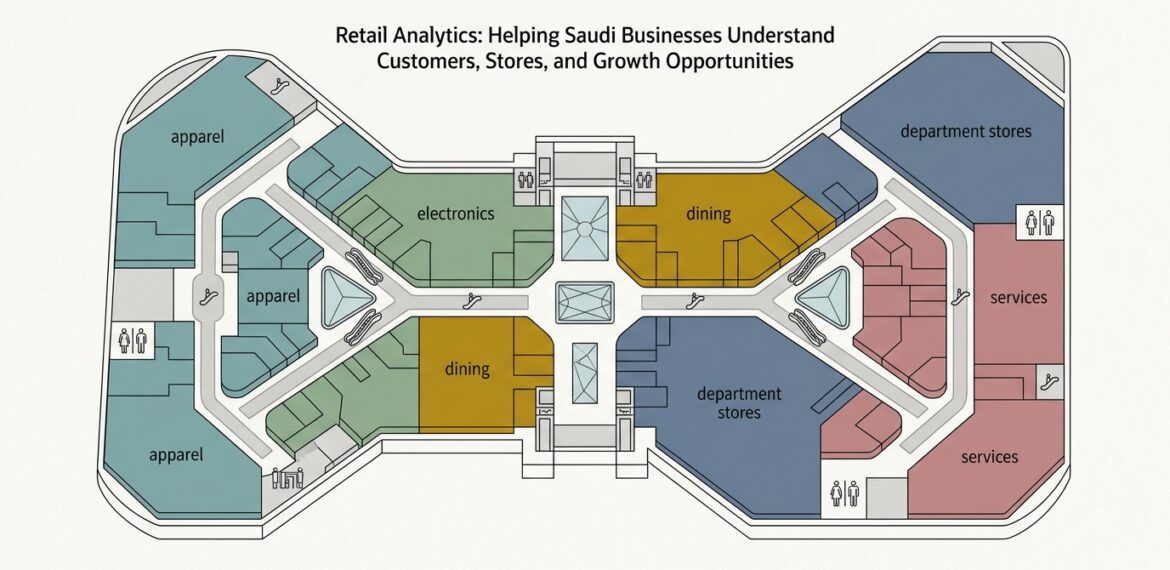
Retail Analytics: Helping Saudi Businesses Understand Customers, Stores, and Growth Opportunities
Retail Analytics: Helping Saudi Businesses Understand Customers, Stores, and Growth Opportunities
 Datahub Analytics Team
Retail in Saudi Arabia is changing quickly.
Customers are moving between physical stores, ecommerce platforms, mobile apps, delivery services, loyalty programs, social media, and digital payment channels. Retailers are no longer managing only shelves and sales counters. They are managing customer journeys, inventory movement, product demand, pricing, promotions, logistics, and digital engagement at the same time.
For Saudi businesses, this shift is closely connected to the Kingdom’s wider digital and economic transformation. Vision 2030 focuses on economic diversification, private sector growth, digital economy development, and new opportunities across sectors such as retail, tourism, logistics, entertainment, and technology. Saudi Vision 2030
In this environment, retail analytics becomes a practical business capability.
It helps retailers understand what customers are buying, where demand is changing, which products are profitable, which stores need attention, which promotions are working, and how inventory should be planned.
For businesses that want to grow in a competitive Saudi market, retail analytics can turn daily sales and customer data into better decisions.
What Is Retail Analytics?
Retail analytics is the use of data, business intelligence, visualization, and advanced analytics to improve retail performance.
It brings together data from point-of-sale systems, ecommerce platforms, inventory systems, loyalty programs, CRM platforms, marketing campaigns, supply chain tools, finance systems, and customer service channels.
The goal is to give retailers a clear view of business performance across customers, products, stores, channels, and operations.
From Sales Reports to Customer Understanding
Traditional retail reporting often focuses on sales totals.
How much did the store sell today?
Which product sold the most?
What was the revenue this month?
These reports are useful, but they do not explain the full picture.
Retail analytics goes deeper. It helps businesses understand who is buying, why demand is changing, which products are purchased together, which promotions influence behavior, which stores are performing well, and which customers are likely to return.
This helps retailers move from basic reporting to smarter business decisions.
Connecting Physical and Digital Channels
Many retailers now operate across both physical and digital channels.
A customer may discover a product on Instagram, compare prices online, visit a store, buy through an app, and later use a loyalty program. If these interactions are not connected, the retailer only sees part of the journey.
Retail analytics helps connect store data, online behavior, campaign data, and customer records.
This creates a more complete view of the customer journey.
Why Retail Analytics Matters in Saudi Arabia
Saudi Arabia has a young, digitally active population, growing ecommerce adoption, expanding retail infrastructure, and increasing customer expectations. Businesses must compete not only on product availability, but also on experience, convenience, speed, and personalization.
Retail analytics helps businesses respond to these expectations with data-driven decisions.
Customer Expectations Are Changing
Customers expect retailers to understand their preferences.
They want relevant offers, accurate stock availability, smooth checkout, faster delivery, and consistent experiences across store and online channels.
Without analytics, retailers may struggle to understand customer needs at scale.
Retail analytics helps identify buying patterns, customer segments, preferred channels, repeat purchase behavior, and loyalty drivers.
This allows businesses to serve customers more effectively.
Competition Requires Better Decisions
Retail competition is increasing across malls, ecommerce platforms, local brands, international brands, delivery apps, and social commerce.
Retailers need to know where they are winning and where they are losing.
Analytics helps answer practical questions:
Which stores are underperforming?
Which products should be promoted?
Which customer segments are growing?
Which channels create profitable sales?
Which campaigns increase repeat purchases?
Which inventory decisions reduce waste?
These insights support faster and better decision-making.
Inventory Planning Is Critical
Inventory is one of the biggest challenges in retail.
Too much inventory increases storage cost and discount pressure. Too little inventory leads to missed sales and poor customer experience.
Retail analytics helps businesses forecast demand, track stock movement, identify slow-moving items, and reduce stockout risk.
This is especially important for retailers operating across multiple branches, cities, warehouses, and online channels.
Key Areas of Retail Analytics
Retail analytics can support many business functions. The strongest value comes when retailers connect customer, product, inventory, sales, marketing, and finance data.
Sales Performance Analytics
Sales analytics helps retailers understand revenue trends across stores, products, categories, regions, and channels.
It can show daily sales, monthly growth, average transaction value, basket size, discount impact, and revenue by location.
For Saudi retailers, this can be useful across major commercial areas such as Riyadh, Jeddah, Dammam, Khobar, Makkah, and Madinah, where customer behavior may differ by location, season, and visitor profile.
Sales analytics helps leaders understand where growth is strong and where action is needed.
Customer Analytics
Customer analytics helps retailers understand who their customers are and how they behave.
It can analyze customer segments, purchase frequency, loyalty activity, repeat purchases, basket value, churn risk, and customer lifetime value.
This helps businesses create better offers, loyalty programs, and personalized campaigns.
For example, a retailer may identify that one customer segment responds well to premium bundles, while another responds better to seasonal offers.
Product and Category Analytics
Product analytics helps retailers understand which products are performing well and which need attention.
It can show bestsellers, slow-moving items, product margins, category growth, return rates, and product combinations.
Category managers can use this insight to plan assortment, pricing, promotions, and shelf space.
Instead of relying only on past experience, teams can make product decisions based on actual demand and profitability.
Inventory Analytics
Inventory analytics helps retailers monitor stock levels, stock movement, replenishment needs, aging inventory, and stockout risk.
It can show which products are running low, which items are overstocked, and which inventory is not moving.
This helps businesses improve availability while reducing unnecessary stock.
Inventory analytics is especially valuable for retailers with multiple stores and warehouses because it helps move stock to where demand is strongest.
Promotion and Discount Analytics
Promotions can increase sales, but they can also reduce margin if not managed properly.
Promotion analytics helps retailers understand whether discounts are actually improving business performance.
It can measure uplift, margin impact, customer response, repeat purchase behavior, and product-level performance.
A promotion may increase revenue but reduce profit. Another may attract new customers who continue buying later. Analytics helps identify the difference.
Store Performance Analytics
Store analytics helps retailers compare branches and locations.
It can show footfall, sales, conversion, average basket value, staff productivity, inventory availability, and customer behavior by store.
This helps leaders identify high-performing stores, underperforming locations, staffing needs, and operational issues.
For physical retail in Saudi Arabia, store analytics can also help understand performance differences during weekends, holidays, Ramadan, Hajj, Umrah seasons, and tourism peaks.
Omnichannel Analytics
Omnichannel analytics connects online and offline customer behavior.
It helps retailers understand how customers move between website, app, social media, store visits, delivery, and loyalty programs.
This is important because modern customers do not think in channels. They expect one connected experience.
Omnichannel analytics helps businesses improve marketing, inventory planning, personalization, and customer service.
The Data Foundation for Retail Analytics
Retail analytics depends on connected and reliable data.
If sales, customer, inventory, ecommerce, marketing, and finance data remain separate, decision-making becomes fragmented.
Connecting POS, Ecommerce, CRM, and Inventory Data
Retailers need to connect data from many systems.
Point-of-sale systems show store transactions. Ecommerce platforms show online orders and browsing behavior. CRM systems show customer profiles. Inventory systems show stock availability. Marketing tools show campaign engagement. Finance systems show margin and profitability.
When these systems are connected, retailers can understand the full business picture.
Modern Data Warehouse for Retail Analytics
A modern data warehouse provides a trusted foundation for retail analytics.
It brings data from multiple systems into one structured environment. This helps create reliable dashboards, customer models, product analysis, and forecasting.
Without a modern data warehouse, retailers often depend on manual exports, spreadsheets, and disconnected reports.
This slows decision-making and increases reporting errors.
Business-Ready Retail Data Models
Retail data should be modeled around business entities.
These may include customers, products, stores, transactions, orders, categories, suppliers, promotions, channels, loyalty accounts, and time periods.
When data is organized around these entities, analysis becomes easier and more meaningful.
Data Quality and Product Mapping
Retail data often has quality challenges.
Product names may differ across systems. Customer records may be duplicated. Store codes may be inconsistent. Promotions may not be tagged correctly. Online and offline customer identities may not match.
Good data quality is essential for trusted retail analytics.
Business Intelligence for Retail Analytics
Business intelligence turns retail data into dashboards and decision tools.
Different users need different views of the business.
Executive Retail Dashboard
Executives need a clear view of retail performance.
This may include revenue, margin, store performance, inventory health, customer growth, promotion impact, and channel performance.
The dashboard should highlight major risks and opportunities without overwhelming users.
Store Operations Dashboard
Store managers need visibility into daily sales, product availability, staff productivity, customer traffic, and target achievement.
This helps them manage daily performance more effectively.
Category Management Dashboard
Category teams need product-level and category-level insights.
They need to know which products are growing, which are declining, which have strong margins, and which need promotion or replacement.
Customer and Loyalty Dashboard
Marketing and CRM teams need customer insights.
A customer dashboard can show repeat purchase rate, loyalty activity, customer segments, churn risk, average basket value, and campaign response.
This helps teams improve customer engagement.
Inventory and Supply Dashboard
Supply chain teams need inventory visibility.
An inventory dashboard can show stock levels, stockout risk, replenishment needs, slow-moving items, supplier performance, and warehouse distribution.
This supports better planning and availability.
How Data Science Improves Retail Analytics
Data science can help retailers move from reporting to prediction and optimization.
Demand Forecasting
Demand forecasting helps retailers predict future product demand.
Models can use historical sales, seasonality, promotions, store location, customer behavior, and external events.
This helps businesses plan inventory more accurately and reduce both stockouts and overstock.
Customer Segmentation
Data science can identify customer groups based on buying behavior, value, frequency, preferences, and channel usage.
This helps retailers create more relevant campaigns and offers.
Better segmentation can improve loyalty, personalization, and conversion.
Product Recommendation
Recommendation models can suggest products based on customer behavior and similar purchase patterns.
This can support ecommerce personalization, loyalty offers, cross-sell campaigns, and in-store assisted selling.
Churn Prediction
Retailers can use predictive analytics to identify customers who are likely to stop buying.
Signals may include reduced purchase frequency, lower basket value, lack of loyalty activity, or declining engagement.
This helps marketing teams launch retention campaigns before customers are lost.
Price and Promotion Optimization
Data science can help analyze how customers respond to pricing and discounts.
This helps retailers design promotions that increase sales without damaging margins unnecessarily.
Retail Analytics and Automation
Retail analytics becomes more powerful when connected with automation.
Analytics identifies the signal. Automation helps trigger the response.
Automated Stock Alerts
If stock falls below a threshold, an alert can notify the store, warehouse, or supply team.
This reduces stockout risk and improves product availability.
Personalized Campaign Triggers
If a customer shows interest in a category or stops purchasing for a period, automated campaigns can be triggered.
This helps improve customer engagement and retention.
Promotion Performance Alerts
If a promotion is underperforming or reducing margin too much, the responsible team can receive an alert.
This allows faster campaign adjustment.
RPA for Retail Reporting
Robotic Process Automation can help prepare recurring sales, inventory, and campaign reports.
It can also support data validation, price checks, stock updates, and report distribution.
This reduces manual effort and improves consistency.
Common Mistakes in Retail Analytics
Retail analytics can create strong value, but only if implemented carefully.
Looking Only at Sales
Sales is important, but it does not show the full picture.
Retailers also need to understand margin, inventory, customer retention, promotion impact, and cost to serve.
Not Connecting Online and Offline Data
If store and digital data remain separate, retailers may not understand the full customer journey.
Omnichannel analytics requires connected data.
Ignoring Inventory Accuracy
Retail decisions depend heavily on inventory data.
If stock data is inaccurate, forecasting, replenishment, and customer experience will suffer.
Overusing Discounts Without Measuring Margin
Discounts may increase sales but reduce profitability.
Promotion analytics should always consider margin impact.
Creating Dashboards Without Action
Retail dashboards should help teams act.
If a dashboard shows stockout risk, campaign underperformance, or declining customer activity, there should be a clear response.
A Practical Roadmap for Retail Analytics
Retailers can build analytics capabilities step by step.
Define Business Priorities
Start with the most important business questions.
Which products are growing?
Which stores need attention?
Where is inventory stuck?
Which customers are most valuable?
Which promotions are profitable?
Which channels create repeat customers?
These questions guide the analytics roadmap.
Connect Core Retail Systems
Connect POS, ecommerce, inventory, CRM, loyalty, marketing, finance, and supply chain systems.
This creates the foundation for reliable analytics.
Build Retail Data Models
Create structured models around customers, products, stores, transactions, inventory, promotions, and channels.
This makes reporting and analysis easier.
Create Role-Based Dashboards
Different teams need different dashboards.
Executives need performance overview. Store managers need daily operations. Marketing needs customer insights. Category teams need product analytics. Supply chain teams need inventory visibility.
Add Predictive Analytics
Once the foundation is ready, add demand forecasting, churn prediction, customer segmentation, product recommendations, and promotion optimization.
Connect Insights to Automation
Use alerts, workflows, RPA, and campaign automation to turn analytics into action.
How Datahub Analytics Can Help
Datahub Analytics helps retailers and enterprises build analytics capabilities that improve customer understanding, inventory planning, store performance, and business growth.
Through its Datahub Analytics services, the company supports big data analytics, modern data warehouse development, business intelligence, data visualization, data science, and robotic process automation. These capabilities help businesses connect retail data, create dashboards, forecast demand, segment customers, optimize promotions, and automate reporting workflows.
Datahub Infrastructure supports the technical foundation required for retail analytics through big data infrastructure, containerized infrastructure, DevOps infrastructure solutions, hybrid cloud infrastructure solutions, and managed infrastructure services. This helps organizations build scalable and reliable analytics platforms for high-volume retail and customer data.
For organizations in Saudi Arabia and the wider region that need additional expertise or delivery capacity, Datahub Outsourcing provides staff augmentation, AI and ML engineers, managed data analytics, data management, PMO services, and Data & Analytics Centre of Excellence support.
By combining analytics, infrastructure, automation, and skilled teams, Datahub Analytics helps businesses turn retail data into clearer decisions and measurable growth.
Conclusion
Retail analytics helps businesses understand customers, products, stores, inventory, promotions, and channels more clearly.
For Saudi retailers, this is especially important as customer expectations, digital adoption, ecommerce, tourism, and competition continue to grow under the broader transformation of the Kingdom’s economy.
With the right data foundation, dashboards, predictive models, and automation workflows, retailers can improve inventory planning, increase customer loyalty, optimize promotions, strengthen store performance, and grow more profitably.
For businesses looking to compete in a fast-changing retail market, retail analytics is a practical and high-impact investment.



