
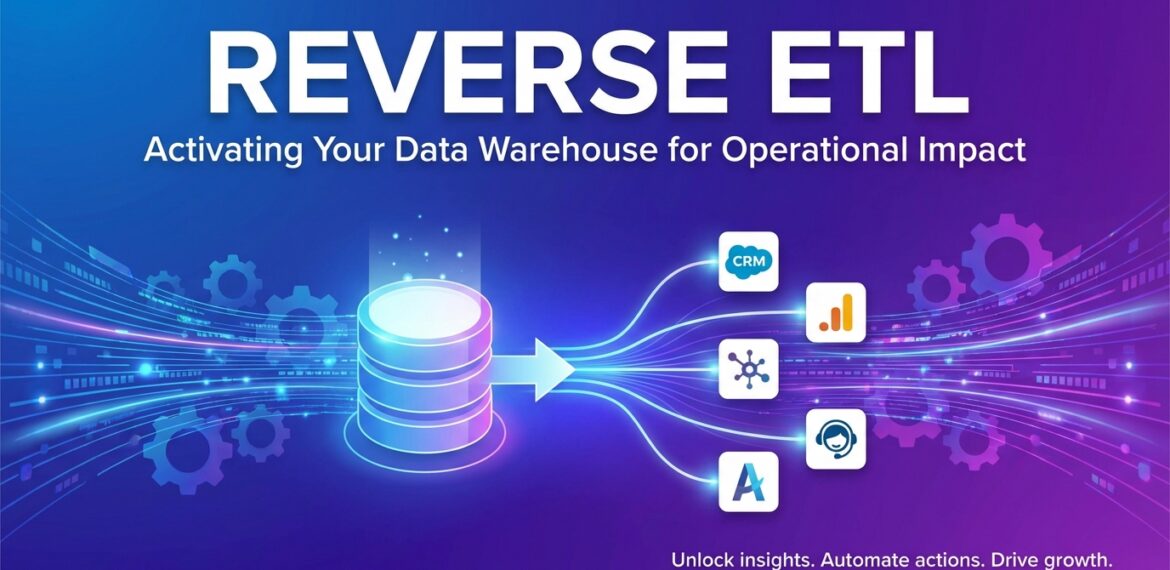
Reverse ETL: Activating Your Data Warehouse for Operational Impact
Reverse ETL: Activating Your Data Warehouse for Operational Impact
 Datahub Analytics Team
For years, enterprises have invested heavily in building centralized data warehouses and lakehouses. These platforms bring together sales data, customer behavior, operational metrics, and financial records into a single analytical environment. But in many organizations, that’s where the journey stops. Insights are generated – but they stay trapped inside dashboards.
The next evolution of analytics is about activation, not just analysis. And that is where Reverse ETL is reshaping how enterprises unlock value from their data.
The Problem: Insights That Don’t Reach the Frontline
Traditional ETL (Extract, Transform, Load) moves data from operational systems into a data warehouse for reporting and analysis. This is essential – but it creates a one-way flow.
Data moves into the warehouse.
Insights are created inside BI tools.
But those insights rarely move back into the operational systems where action happens.
For example:
-
Marketing sees high-value segments in a dashboard, but CRM systems don’t reflect them.
-
Sales identifies churn risks in BI, but frontline reps don’t see the signals.
-
Operations tracks bottlenecks in reports, but workflow systems remain unchanged.
This disconnect limits the business impact of analytics.
What Is Reverse ETL?
Reverse ETL flips the traditional model. Instead of only moving data into the warehouse, it pushes curated, analytics-ready data back into operational tools.
In simple terms, Reverse ETL:
-
Extracts enriched data from the warehouse
-
Transforms it into business-ready objects
-
Loads it into operational systems like CRM, marketing platforms, support tools, and product applications
This turns the data warehouse from a reporting destination into a central intelligence hub.
Why Reverse ETL Matters Now
Several trends are driving the need for Reverse ETL.
First, organizations increasingly centralize their logic in modern data platforms. Segmentation, churn prediction, lifetime value models, and scoring systems are built in the warehouse – not in individual SaaS tools.
Second, business teams rely on operational platforms like Salesforce, HubSpot, ServiceNow, or custom apps to execute their work. If insights don’t appear inside these tools, adoption drops.
Third, real-time personalization and automation require insights to be embedded directly into customer-facing workflows.
Reverse ETL bridges this gap between analytics and action.
From Reporting to Activation
The shift enabled by Reverse ETL is strategic. Analytics stops being a passive reporting function and becomes an operational driver.
Instead of asking, “What happened?”, organizations can:
-
Automatically assign high-priority leads in CRM
-
Trigger personalized campaigns based on warehouse-driven segments
-
Alert account managers about churn risks
-
Update product experiences dynamically
-
Adjust support routing based on customer value
Analytics becomes embedded into everyday processes.
How Reverse ETL Works in Practice
A typical Reverse ETL workflow starts with clean, modeled data inside a warehouse or lakehouse. Business logic – such as scoring models, segmentation rules, or calculated metrics – is applied centrally.
Reverse ETL tools then synchronize this data into operational systems on a scheduled or near real-time basis. Field mappings ensure the right attributes land in the correct CRM objects, marketing lists, or support queues.
The result is a consistent feedback loop:
Operational systems generate raw data →
Data warehouse refines and enriches it →
Reverse ETL pushes insights back into operational tools →
Business teams act on enriched intelligence.
Key Use Cases for Reverse ETL
Reverse ETL delivers strong impact across several domains.
Customer Segmentation
Marketing teams can push warehouse-defined segments directly into campaign tools, ensuring consistency across channels.
Churn Prediction
Customer success platforms can receive updated risk scores to prioritize outreach.
Lead Scoring
Sales teams can access predictive scores directly inside CRM systems.
Personalized Product Experiences
Applications can adapt in real time based on analytics-generated attributes.
Revenue Intelligence
Pipeline health metrics and opportunity insights can be embedded in sales workflows.
In each case, the goal is simple: bring analytics closer to action.
Reverse ETL vs API Integrations
Some organizations attempt to solve activation through custom APIs or manual exports. While possible, these approaches often become brittle and inconsistent.
Reverse ETL centralizes transformation logic and synchronization rules in the warehouse, ensuring:
-
Single metric definitions
-
Consistent data mappings
-
Reduced duplication of business logic
-
Easier governance and monitoring
It reduces technical debt while increasing agility.
The Governance Dimension
Activation increases responsibility. When data flows back into operational systems, quality and governance become even more critical.
Organizations must ensure:
-
Data is accurate and validated
-
Access controls are enforced
-
Sensitive attributes are handled properly
-
Synchronization processes are monitored
-
Audit trails are maintained
Reverse ETL is not just about movement – it’s about trusted movement.
Challenges in Implementing Reverse ETL
While powerful, Reverse ETL requires careful planning.
Common challenges include:
-
Poorly modeled warehouse data
-
Conflicting definitions across teams
-
Over-synchronization creating system clutter
-
Lack of ownership over activated data
-
Integration complexity with legacy systems
Success depends on strong data modeling and clear business objectives.
Reverse ETL and the Modern Data Stack
Reverse ETL is a natural extension of the modern data stack. As organizations centralize transformation logic in the warehouse using tools like dbt or SQL-based modeling, Reverse ETL ensures that the warehouse becomes the “source of truth” not just for reporting – but for operations.
Combined with event-driven architectures and real-time analytics, Reverse ETL supports continuous, intelligent workflows.
How Datahub Analytics Helps Activate Enterprise Data
Datahub Analytics supports organizations in designing and implementing Reverse ETL strategies that align with business objectives.
Our capabilities include:
-
Designing warehouse-centric data models
-
Identifying high-impact activation use cases
-
Implementing Reverse ETL pipelines securely
-
Ensuring data governance and compliance
-
Integrating analytics into CRM, marketing, and operational systems
-
Supporting teams with managed analytics and engineering expertise
We help enterprises move beyond dashboards – embedding intelligence where decisions are made.
Conclusion: Data Creates Value Only When It Drives Action
Building a modern data warehouse is a powerful step. But its true value is realized only when insights influence operations.
Reverse ETL transforms the warehouse from a passive reporting layer into an active intelligence engine. It ensures that the insights generated by analytics teams are not confined to dashboards – but flow directly into the systems where business happens.
In the future of enterprise analytics, the most successful organizations will not just analyze data.
They will activate it.



