
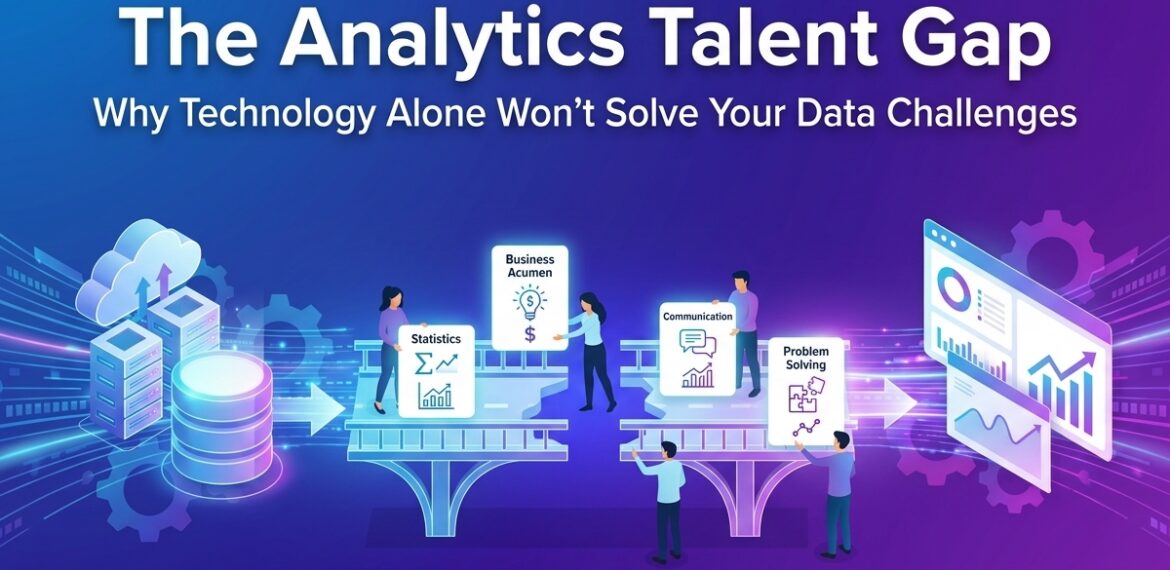
The Analytics Talent Gap: Why Technology Alone Won’t Solve Your Data Challenges
The Analytics Talent Gap: Why Technology Alone Won’t Solve Your Data Challenges
 Datahub Analytics Team
Enterprises have never had more access to data, cloud platforms, AI tools, and automation capabilities than they do today. Yet despite these investments, many organizations still struggle to generate consistent business value from analytics. Dashboards are built but underused. Data platforms are modernized but underleveraged. AI initiatives launch but stall before impact.
The problem is often not the technology. It is the analytics talent gap.
As data ecosystems become more sophisticated, organizations are discovering that success depends just as much on the right people, roles, and operating models as it does on tools and platforms. Technology can accelerate analytics, but it cannot replace the human capability required to design, govern, interpret, and activate it effectively.
Why the Analytics Talent Gap Is Growing
The demand for analytics capabilities has expanded far beyond traditional reporting. Today, organizations need expertise in:
- Data engineering
- Business intelligence
- Cloud data architecture
- Data governance
- Machine learning and AI
- Prompt engineering
- Data product management
- Analytics translation between business and technical teams
At the same time, the market for experienced talent remains highly competitive. Enterprises are not only competing with peers in their industry – they are competing with global technology firms, startups, and consulting ecosystems for the same limited pool of skilled professionals.
As a result, many organizations find themselves with ambitious data roadmaps but insufficient internal capacity to execute them.
Why Hiring More People Isn’t Always the Answer
A common reaction to the talent gap is simply to hire more analysts or engineers. But scaling headcount alone often does not solve the underlying issue.
Many organizations face challenges such as:
- Unclear role definitions
- Overlap between analytics, engineering, and BI teams
- Bottlenecks caused by centralized operating models
- Skill mismatches between current needs and available talent
- Difficulty retaining high-performing specialists
Without the right structure and strategy, adding more people can increase cost without increasing impact.
The Hidden Cost of Talent Gaps
When analytics roles are understaffed or misaligned, the effects ripple across the organization.
Projects take longer to launch.
Data quality issues remain unresolved.
Business teams lose trust in dashboards.
Executives wait too long for strategic insights.
AI initiatives become difficult to operationalize.
Over time, this slows innovation and reduces the return on every technology investment the organization has already made.
In many cases, the real cost of the talent gap is not payroll – it is missed opportunity.
The Skills Enterprises Need Most Now
The analytics talent gap is not limited to one role. It reflects a broader shortage of cross-functional capability.
Some of the most in-demand roles today include:
Data Engineers, who build scalable pipelines and modern data foundations.
BI Developers, who translate raw data into usable reporting and dashboards.
Data Scientists and AI/ML Engineers, who operationalize predictive and intelligent capabilities.
Data Governance Specialists, who ensure trust, compliance, and quality.
Analytics Translators, who connect business priorities with technical execution.
Cloud Data Architects, who design future-ready analytics ecosystems.
The most successful organizations do not just hire isolated specialists – they build balanced teams.
Why Business Context Matters as Much as Technical Skill
One of the most overlooked dimensions of analytics talent is business understanding. Technical expertise alone is not enough if teams cannot connect analytics to strategic priorities, customer needs, or operational realities.
Strong analytics professionals know how to:
- Ask the right business questions
- Translate data into decision-ready insight
- Align KPIs with organizational goals
- Design analytics experiences for real users
- Influence action, not just reporting
This is why the best analytics teams are not just technically capable – they are commercially and operationally aware.
Build, Borrow, or Augment? Rethinking the Talent Model
Given the difficulty of hiring and retaining every skill internally, many enterprises are rethinking how they build analytics capability.
Increasingly, organizations are using a blended model that includes:
- Internal core teams for strategic ownership
- Staff augmentation for specialized or hard-to-hire roles
- Managed analytics services for scalable delivery
- External partners for acceleration and transformation support
This model gives organizations flexibility while reducing the risk of long hiring cycles or capability gaps.
The Role of Operating Model in Closing the Gap
Talent alone is not enough without the right operating model. Even highly skilled teams struggle in environments where responsibilities are unclear or workflows are fragmented.
Organizations that close the analytics talent gap effectively often:
- Define clear ownership across data domains
- Separate platform, product, and reporting responsibilities
- Align analytics priorities with business value
- Invest in reusable assets and shared frameworks
- Build collaboration between business and technical teams
The right operating model amplifies the value of every hire.
Upskilling Is Part of the Solution
Not every capability gap requires external hiring. In many cases, the most scalable strategy is to upskill existing teams.
Modern analytics environments increasingly require professionals to broaden their capabilities. BI teams may need AI literacy. Engineers may need stronger governance understanding. Business users may need better data fluency.
Targeted upskilling helps organizations:
- Increase agility
- Improve cross-functional collaboration
- Reduce dependency on niche hires
- Future-proof internal talent
The goal is not to turn everyone into a data scientist, but to raise the organization’s overall analytics maturity.
How Datahub Analytics Helps Close the Talent Gap
Datahub Analytics helps enterprises overcome analytics capability gaps through a combination of strategic support, managed services, and staff augmentation.
Our capabilities include:
- Data Engineers
- BI Developers
- AI/ML Engineers
- Data Governance Specialists
- Data Scientists
- Cloud and Analytics Architects
- Managed Data Analytics teams
- Analytics Centre of Excellence support
We help organizations strengthen both execution capacity and long-term capability – so that technology investments translate into measurable business outcomes.
Conclusion: Analytics Success Is a People Strategy as Much as a Technology Strategy
Modern data platforms, BI tools, and AI systems are powerful – but they do not create value on their own. The organizations that succeed in analytics are those that pair technology with the right talent, operating models, and strategic focus.
The analytics talent gap is real, but it is solvable. Enterprises that address it thoughtfully will move faster, make better decisions, and unlock far more value from their data investments.
In the future of enterprise analytics, the strongest advantage may not be who has the most tools – but who has the right people to use them well.



