
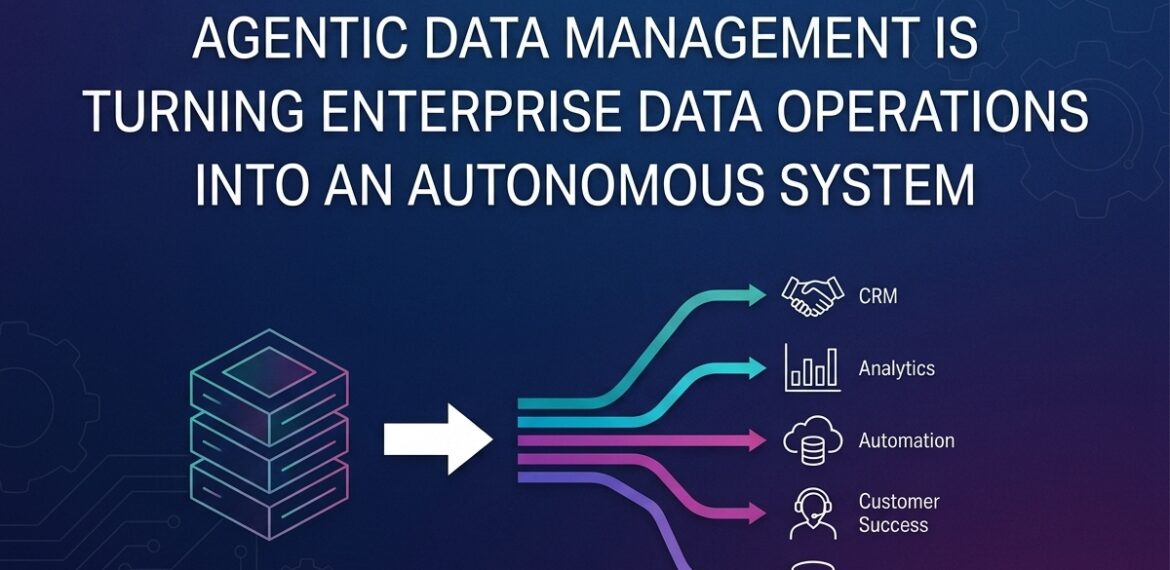
Agentic Data Management Is Turning Enterprise Data Operations Into an Autonomous System
Agentic Data Management Is Turning Enterprise Data Operations Into an Autonomous System
 Datahub Analytics Team
Enterprise data management is entering a new phase. For years, data teams focused on pipelines, overnance programs, quality checks, cataloging, stewardship, and manual operational oversight. Those disciplines still matter, but in 2026 a new pattern is becoming increasingly visible: AI is starting to automate parts of data management itself. Recent reporting says AI could automate up to 50% of enterprise data work within the next 12 to 18 months, especially across data discovery, integration, governance, and quality management. At the same time, Gartner’s 2026 data and analytics outlook emphasizes AI’s growing role across governance, operations, and context-rich analytics environments.
This matters because modern data operations have become too complex to manage efficiently through manual effort alone. Enterprises are dealing with growing data volumes, hybrid architectures, AI-generated content, increasing governance demands, and pressure to move from pilot AI projects into real production systems. In that environment, agentic data management is emerging as a practical next step. It applies AI agents and intelligent automation to data management workflows so the platform can not only describe and monitor the data estate, but increasingly help operate it.
Why Traditional Data Management Operating Models Are Under Pressure
Most data management functions were built for a world where people remained the primary operators of the data environment. Teams built ingestion pipelines, reviewed quality issues, updated catalogs, managed classifications, responded to incidents, and coordinated governance through a mix of manual processes and fixed rules.
That model is now under strain. Data environments are more fragmented than before, AI is creating new governance and quality pressures, and business users expect faster, more trusted access to data for analytics and decision-making. BARC’s 2026 trend research continues to emphasize that organizations getting value from AI are the ones investing in governance, security, quality, and strong fundamentals. The challenge is that those fundamentals now have to operate at far greater scale and speed.
This is where agentic data management becomes relevant. Instead of asking humans to manually coordinate every operational detail, enterprises are beginning to use AI to assist with monitoring, classification, quality triage, orchestration, and workflow execution inside the data estate itself.
What Agentic Data Management Actually Means
Agentic data management means using AI agents to support or automate data management activities that traditionally required more human intervention. These activities may include discovering assets, identifying schema changes, classifying data, flagging anomalies, recommending remediation steps, enforcing governance actions, or helping orchestrate data workflows across systems.
In simple terms, the data platform becomes more active. It does not only store metadata or surface alerts. It begins to interpret conditions, propose actions, and in some cases execute approved workflows. Recent enterprise platform announcements describe this direction clearly, positioning autonomous agents as a way to unify planning, intelligence, governance, and systems integration across enterprise operations.
This does not mean humans disappear. It means the operating model changes. People spend less time on repetitive operational work and more time on policy, architecture, business alignment, and high-value decisions.
Why This Trend Is Growing in 2026
One reason is the growing pressure to move AI from pilot mode into production. Recent reporting on Snowflake and Anthropic highlights the ongoing enterprise struggle with “pilot purgatory,” noting that security and compliance remain major barriers to production-scale AI. As organizations try to operationalize AI, they also need more scalable ways to manage the data foundations beneath it.
Another reason is the rise of AI agents as an enterprise operating model. AI agents are no longer being discussed only as user-facing assistants. They are increasingly being positioned as operational participants that can support workflows, systems integration, and decision execution. That broader shift naturally extends into the data layer as well.
A third reason is simple economics. Data teams are under pressure to do more with existing staff while handling more complexity. If AI can automate a meaningful share of discovery, governance support, integration support, and quality management, then data operations become more scalable without depending entirely on linear headcount growth.
Why Agentic Data Management Matters for Analytics Teams
This trend is not only relevant to platform or engineering teams. It matters directly to analytics leaders as well.
Analytics depends on trusted data, clear definitions, fresh assets, and reliable governance. When data operations are slow or fragmented, dashboards become inconsistent, self-service becomes harder to trust, and AI-enabled analytics becomes less reliable. Agentic data management can help by making the underlying data environment more responsive. If quality issues are detected earlier, if lineage gaps are flagged faster, or if governance actions happen with less delay, analytics becomes more dependable.
This becomes even more important as analytics converges with AI. Conversational BI, AI copilots, and agent-assisted analytics all depend on data environments that are not only technically available, but also actively governed and continuously maintained. Agentic data management supports that foundation by making the operational layer more intelligent and less reactive.
The Link Between Agentic Data Management and Governance
One of the most important aspects of this trend is that it is not just about automation. It is also about governed automation.
As AI starts taking a larger role in discovery, classification, quality response, and workflow execution, the enterprise needs stronger governance around what agents are allowed to do, what data they can access, and how their actions are monitored. Recent industry coverage on enterprise AI repeatedly points to governance and safety as core conditions for moving from experimentation to production.
This is why agentic data management should not be understood as uncontrolled autonomy. The real value comes when AI agents operate within clear policy boundaries, with observability, approval logic, and accountability built into the operating model. That allows enterprises to gain efficiency without weakening trust.
Where Enterprises Can Gain the Most Value
One strong use case is data quality operations. Many organizations still rely on manual review and reactive issue handling when data breaks or drifts. Agentic systems can help detect anomalies, prioritize issues, suggest remediation, and reduce time-to-response.
Another major area is metadata and discovery. Enterprises often struggle to keep catalogs current and useful. AI agents can help classify new assets, infer relationships, detect stale information, and keep metadata more actionable.
Governance workflows are another high-value fit. Policy tagging, sensitivity detection, certification reminders, and lineage-based impact checks are all areas where agentic support can reduce friction while improving control. Recent commentary around enterprise data work automation points directly to governance and quality as areas where AI can take a larger role.
Integration and operational orchestration are also promising. As hybrid and multi-system environments become more common, agentic systems can help coordinate routine data movement and maintenance tasks more efficiently across the stack.
Why This Trend Also Changes the Role of the Data Team
As agentic data management grows, the work of the data team changes as well.
Instead of spending as much time on repetitive administration, teams can focus more on designing standards, defining controls, aligning data products to business needs, and supervising how automation behaves. In other words, data teams become less like manual operators and more like designers and governors of intelligent data systems.
This shift is important because it aligns with a broader enterprise pattern. AI is not only changing end-user experiences. It is changing how core enterprise functions operate internally. Data management is one of those functions, and it is increasingly moving from tool-centric administration to intelligence-assisted operations.
Common Mistakes Companies Make
One common mistake is assuming agentic data management is only about efficiency. Efficiency is part of the value, but the larger opportunity is better control, faster trust signals, and more scalable governance across a complex data estate.
Another mistake is adopting agentic tooling without clear policy boundaries. If AI agents are allowed to discover, classify, or act without guardrails, the business may create new governance risks instead of solving old ones. The same production-readiness concerns that affect broader enterprise AI also apply here.
A third mistake is treating this as a replacement for data teams. In reality, the strongest results come when agents handle repetitive operational work while human teams remain responsible for architecture, policy, business meaning, and oversight.
How to Start with an Agentic Data Management Strategy
A practical starting point is to identify the data management workflows that are repetitive, rules-heavy, and already creating operational bottlenecks. That may include quality monitoring, metadata upkeep, governance tagging, lineage impact checks, or basic integration support.
From there, the organization should define where AI agents can safely assist first, what approvals are required, and what success metrics matter. The goal is not to automate the entire data estate at once. It is to make specific high-friction processes more intelligent and more scalable while keeping governance intact. Recent enterprise AI production trends suggest this stepwise approach is far more realistic than trying to transform everything at once.
How Datahub Analytics Can Help
At Datahub Analytics, we help organizations modernize their data and analytics environments so governance, trust, and AI-readiness can scale together. That includes modern data architecture, business intelligence transformation, metadata strategy, governance frameworks, and AI-ready analytics foundations.
If your organization is struggling with slow data operations, fragmented governance, growing quality pressure, or AI initiatives that are moving faster than the underlying data management model can support, agentic data management should be on the roadmap. The real opportunity is not only to automate more work. It is to create a smarter, more resilient operating model for the enterprise data estate.
Conclusion
Agentic data management is rising because enterprise data operations are becoming too complex to manage effectively through manual effort alone. Recent 2026 signals show that AI is starting to automate significant portions of enterprise data work, while broader market movement continues to push AI from isolated pilots into governed production environments.
The next phase of enterprise analytics will depend not only on stronger platforms and better dashboards, but also on how intelligently the underlying data environment can operate. Organizations that build agentic data management well will be better positioned to improve trust, reduce operational friction, and support AI-enabled analytics at much greater scale.



