
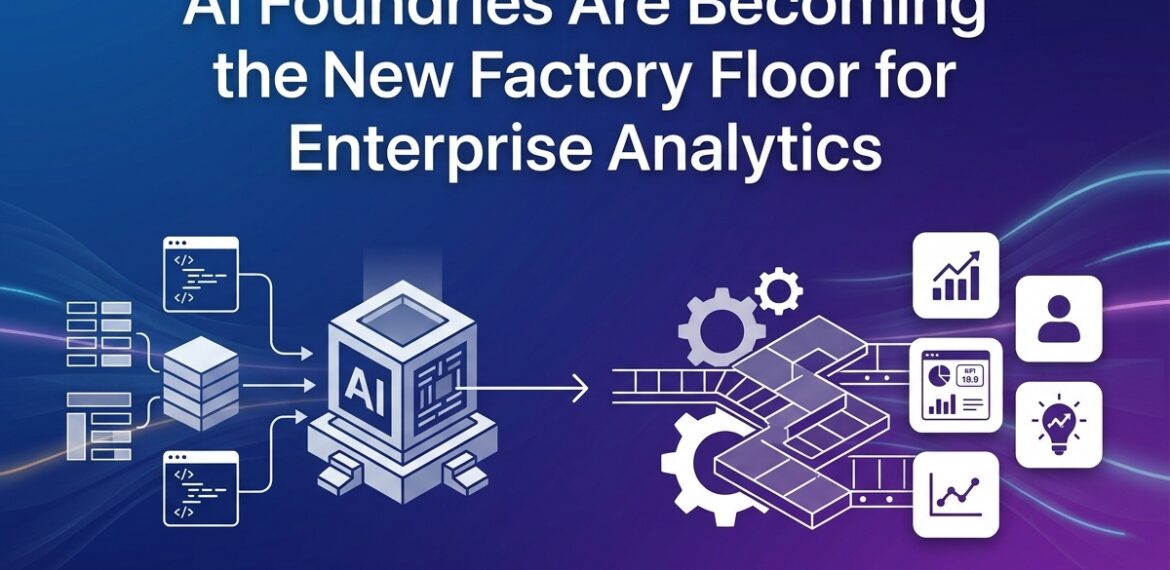
AI Foundries Are Becoming the New Factory Floor for Enterprise Analytics
AI Foundries Are Becoming the New Factory Floor for Enterprise Analytics
 Datahub Analytics Team
Enterprise AI is moving into a more industrial phase. Over the last two years, many organizations experimented with models, copilots, and isolated use cases. In 2026, the conversation is shifting toward how enterprises can operationalize AI at scale with stronger governance, shared tooling, and production-ready workflows. Recent coverage describes this shift as a move from hype to accountable deployment, while Snowflake and Anthropic’s expanded partnership is explicitly positioned around helping enterprises move AI from pilot to production.
That is why the idea of an AI foundry is becoming more relevant. The term is being used more broadly across the market to describe a structured enterprise environment where models, data, tools, governance, orchestration, and deployment practices come together in a repeatable system. TechRadar’s 2026 coverage on foundries argues that enterprises are increasingly looking for integrated environments rather than fragmented AI tooling, while broader 2026 reporting shows that agentic enterprise systems are pushing AI much closer to day-to-day business operations.
Why Isolated AI Pilots Are No Longer Enough
Many enterprises started AI adoption through individual pilots. One team tested a chatbot. Another tried document summarization. Another explored analytics copilots. These experiments were useful, but they also created a common problem: scattered AI initiatives without a clear production operating model. The Snowflake and Anthropic partnership coverage points directly to this “pilot to production” challenge, noting that only a minority of AI initiatives make it to production because security, governance, and operational readiness often lag behind experimentation.
This is where the foundry idea becomes useful. Instead of treating each AI use case as a separate project with its own stack and controls, enterprises are beginning to look for a more standardized environment for building, governing, deploying, and monitoring AI systems. That shift aligns with wider 2026 big data and analytics commentary emphasizing trust, observability, and scalable foundations rather than disconnected experimentation.
What an AI Foundry Actually Means
An AI foundry is not just a model catalog or a prompt playground. It is a production-oriented environment for assembling enterprise AI capabilities in a more repeatable way. In practical terms, that usually means bringing together governed data access, model access, orchestration, security controls, monitoring, and workflows for deploying AI into real business use cases. TechRadar’s 2026 foundry coverage describes this as a response to fragmentation across specialized AI tools, with enterprises increasingly wanting a more integrated and governable architecture.
In simple terms, the foundry approach treats AI less like a one-off experiment and more like a managed production system. That matters because enterprises are not only trying to use AI. They are trying to use AI repeatedly, safely, and across multiple workflows. Recent reporting on agent-first systems and enterprise AI infrastructure shows this broader movement clearly, with major vendors and platform players designing for AI as an operating layer rather than an isolated feature.
Why This Trend Is Growing in 2026
One reason is that enterprise AI adoption is getting more serious. Snowflake and Anthropic are explicitly focusing on helping customers operationalize AI agents for analytics, operations, and customer service with stronger governance and security, which reflects the market’s shift from experimentation toward scale.
Another reason is that infrastructure itself is being redesigned around AI workloads. Recent reporting on Foxconn and Intel’s partnership highlights how fast AI infrastructure needs are changing across inference, agentic processing, interconnects, telemetry, and data center design. At the same time, Microsoft’s Project Solara shows that enterprise hardware and cloud environments are increasingly being designed around agent-first architectures rather than traditional app-only computing. These signals together point to a broader industrialization of enterprise AI.
A third reason is that enterprises are demanding stronger control over the full AI lifecycle. Big data trend coverage in 2026 increasingly emphasizes the ability to trust and act on data quickly, not just collect it. A foundry model fits that need because it creates a more controlled environment for how data, models, and workflows are combined.
Why AI Foundries Matter for Enterprise Analytics
This trend is highly relevant for analytics leaders, not just AI engineers. Modern analytics is increasingly converging with AI through conversational BI, copilots, agentic workflows, and embedded decision support. When those capabilities are deployed without a common production framework, analytics quality, governance, and consistency can break down quickly. Snowflake and Anthropic’s positioning around governed AI agents for data analysis and operations illustrates exactly why analytics teams need more than isolated tooling.
An AI foundry model helps analytics by creating a more repeatable way to connect governed data, approved models, orchestration, and deployment into business-facing experiences. That can support analytics copilots, internal knowledge assistants, operational decision tools, and customer-facing intelligence without requiring every team to rebuild the same governance and deployment layer from scratch. Broader 2026 analytics commentary also stresses that the real KPI is increasingly speed-to-insight with trust, not just dashboard volume, which makes this production model even more important.
The Link Between AI Foundries and Data Governance
One of the biggest reasons foundries matter is governance. AI becomes much harder to manage when model access, prompt logic, data permissions, monitoring, and output controls are distributed across separate tools and teams. Recent reporting repeatedly points to security and compliance as the main reasons AI projects struggle to move into production. A foundry approach addresses that by making governance part of the operating environment rather than an afterthought.
This matters especially in analytics-rich environments, where AI systems may access sensitive customer data, financial metrics, operational records, or internal documentation. A foundry makes it easier to centralize approved patterns for data access, model usage, and deployment controls. The broader 2026 trend conversation around trustworthy data, governance, and AI operations strongly supports this direction.
Where Enterprises Can Gain the Most Value
One strong use case is analytics copilots. These systems need governed access to enterprise data, approved models, and controlled deployment patterns. A foundry model helps standardize how those pieces work together.
Another important use case is agentic workflows across operations and customer service. Microsoft’s Solara announcement and Snowflake’s Cortex expansion both point toward AI agents becoming more embedded in enterprise work, from frontline interactions to operational support. A foundry helps turn those agents into governed enterprise assets rather than disconnected experiments.
A third area is enterprise-wide AI rollout. When multiple business units want AI capabilities at once, the enterprise needs shared infrastructure, shared controls, and reusable workflows. AI infrastructure reporting from Foxconn and Intel reflects how seriously the market is taking this scaling challenge.
Why This Also Changes the Role of the Data Team
As enterprises adopt foundry-style AI environments, data teams become more important, not less. Their role shifts from only preparing datasets or feeding dashboards to helping design the governed production environment that AI systems depend on. That includes metadata, quality, security, access logic, semantic consistency, and deployment readiness. The stronger the foundry, the more it depends on reliable data foundations. This is consistent with 2026 reporting that ties sustainable AI progress to stronger governance and data fundamentals.
This means analytics and data leaders are increasingly part of enterprise AI operations, not just downstream consumers of AI outputs. In a foundry model, data is no longer just input. It is part of the factory system itself.
Common Mistakes Companies Make
One common mistake is assuming an AI foundry is just a new branding layer for existing tools. In reality, the value comes from operational integration: governed data, deployment workflows, controls, orchestration, and repeatability. Without those elements, the enterprise still has fragmented pilots, just with a new label.
Another mistake is focusing only on models. Recent market signals show that infrastructure, security, telemetry, and production governance are becoming just as important as model choice. The Foxconn-Intel partnership and the Snowflake-Anthropic expansion both reflect this broader view.
A third mistake is ignoring the analytics layer. If AI is going to support BI, operations, customer engagement, and decision-making, then foundry design has to include analytics context and governed data access from the beginning.
How to Start with an AI Foundry Strategy
A practical starting point is to identify which AI initiatives are already hitting the same production barriers: weak governance, repeated integration work, inconsistent controls, slow deployment, or difficulty scaling across teams. Those recurring problems usually signal the need for a foundry-style operating model rather than more isolated pilots.
From there, the organization should focus on the shared layers first. That includes governed data access, approved model pathways, orchestration patterns, security controls, and monitoring. The goal is not to centralize everything overnight. It is to build a reusable production environment that makes future AI deployment faster and safer. Current 2026 market reporting strongly suggests that enterprises making this shift are better positioned to escape pilot purgatory.
How Datahub Analytics Can Help
At Datahub Analytics, we help organizations build modern data and analytics foundations that support AI at production scale. That includes modern data architecture, business intelligence transformation, governance frameworks, semantic consistency, and AI-ready analytics environments designed for trust and operational reuse.
If your organization is expanding AI beyond isolated pilots and struggling with fragmented tooling, repeated deployment effort, or weak governance around analytics-driven AI, an AI foundry approach can provide a stronger path forward. The opportunity is not only to use more AI. It is to industrialize AI in a way the business can trust.
Conclusion
AI foundries are rising because enterprise AI is moving from experimentation into industrial-scale deployment. Recent 2026 reporting shows the same pattern from different angles: partnerships aimed at moving AI into production, infrastructure redesigned for inference and agents, and growing demand for trustworthy foundations rather than fragmented pilots.
The next phase of enterprise analytics and AI will not be defined only by which model an organization uses. It will be defined by whether the enterprise can build a repeatable production system where data, governance, orchestration, and AI deployment work together. That is why the AI foundry is becoming one of the most important operating models in the future of enterprise analytics.



